
The authority’s freephone number takes reports, not questions
80 205 352 and 80 980 025
Two free numbers circulate in Hungary around gambling, and the 2 of them do completely different things. One runs around the clock but through an answering machine; the other is alive on weekday afternoons, a person answers, and the organisation funding it is itself a licensed gambling operator.
If someone writes “call the authority’s free helpline”, they are recommending the worse of the 2 numbers for the purpose the reader actually has.
The two lines are not variants of one another. Their operators differ, their hours differ, and the most important difference is that on one of them nobody talks to you at all.
A note for a caller who does not speak Hungarian
Neither provider publishes a language of service on the pages we read, and we did not call either number, so we do not state whether an English-speaking person answers.
That is not a detail to skip past. If you are in Hungary and your Hungarian is limited, a two-minute recorded message in a language you are unsure of is a poor place to start, and knowing in advance which of the two numbers is a conversation and which is a recording matters more, not less. The rest of this page is about that difference.
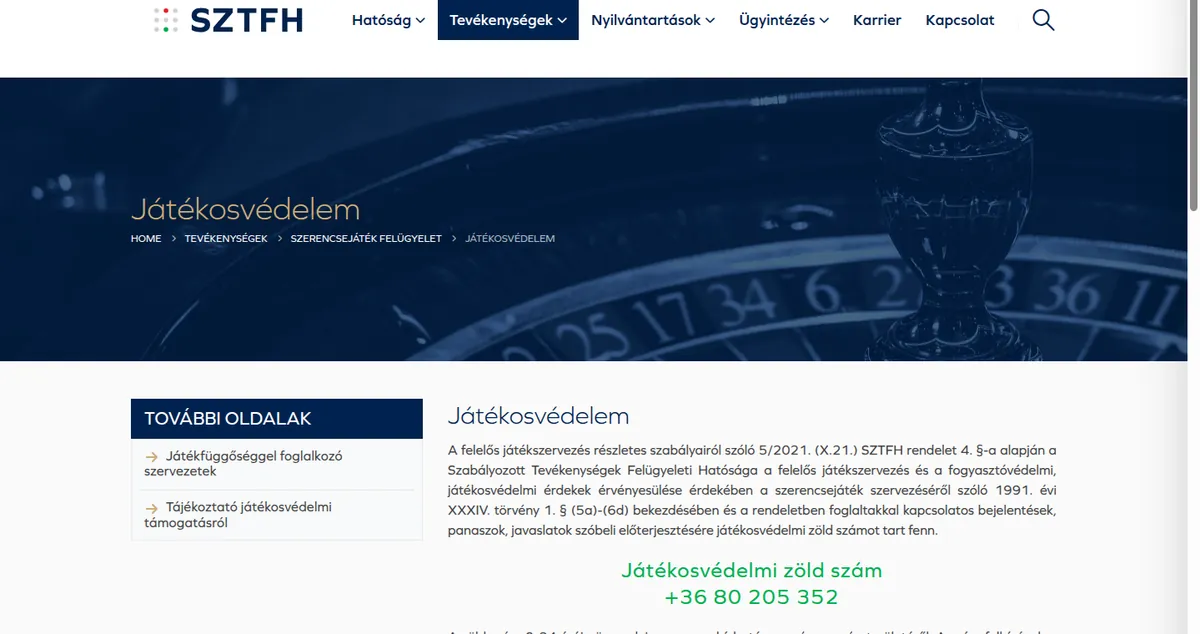
The authority’s freephone number: 80 205 352
According to the SZTFH player-protection page,
„A zöld szám 0–24 óráig üzemel, ingyenesen hívható az egész ország területéről.”
The freephone number operates 24 hours a day and can be called free of charge from anywhere in the country. Up to that point it all sounds like a helpline. The next sentence, though, says what happens during the call:
„A szám felhívásakor egy rövid üdvözlő üzenetet követően, a sípszó után van lehetőség a bejelentés megtételére, melyre az ügyfeleknek 2 perc áll rendelkezésére.”
After a short greeting and a beep, the caller may make a report, for which two minutes are available.
Greeting, tone, two minutes.
Why this is a reporting channel and not a helpline
Because the caller does not get an answer; they leave a message.
It is excellent for telling the authority that a site is organising games without a permit, or that an advertisement breaks the rules. That report also lands somewhere sensible, since the same authority keeps the registers of restrictions.
It is not suited to a person in trouble at two in the morning speaking to somebody.
Hungarian-language summaries almost never draw that distinction. The formula “free, 24 hours” sounds like a helpline on its own, and nobody quotes the sentence that follows it. Lifting one of two adjacent sentences and dropping the other is exactly the same editorial move as leaving the limiting clause out of a petty offence provision.
What to say in the two minutes
If you are making a report, the time available is short, and the authority’s register shows what kind of data it can work with at all.
The columns of the blocked-websites table hold a domain, the name of the organisation or person named as the organiser, and a banking identifier. Those three items are what a record is built from.
From which follows what is worth saying before the two minutes run out. The domain, precisely, spelled out, with the subdomain if that matters. The name of the organiser, if it appears in the site’s footer. And whether there is a payment trail — that is, where money was transferred, if it was.
What is not worth cramming in is your own story. Not because it is unimportant, but because a recorded message is not a conversation, and there is nobody on the other side who could ask you a follow-up.
Telling that story is what the other number is for, and there you do not have two minutes.
The advice line: 80 980 025
The Szerencsejátékos Segélytelefon can be called free of charge on weekdays between 15:00 and 19:00. This is the number where you can genuinely talk: the service is run by the Institute of Psychology of ELTE PPK and the Pro Psychologia Foundation.
Two restrictions come with it. One is the time window: four hours on weekday afternoons, so it is unavailable at night and at weekends.
The other is more important.
The funder of the advice line is a gambling operator
The Szerencsejátékos Segélytelefon is funded by Szerencsejáték Zrt., the state lottery company.
The same company appears on the authority’s register of authentic permits, on the remote gambling tab, as the holder for tippmixpro.hu. So anyone calling this number is using a service maintained by a licensed gambling organiser. That row on the Hungarian permit list can be looked at by anybody.
We do not write this as an accusation, and we do not claim that the professionals working on the line would distort anything for anyone’s benefit. The identity of the funder is a fact in itself, and a caller has a right to know it before they pick up the phone. Elsewhere that sentence is not usually printed beside the number.
It is worth seeing how specific that role is. The remote gambling tab of the authority’s register names the company as the holder for tippmixpro.hu, valid until 23 October 2027. So it is not “the state” in general behind the line, but a permit holder whose authorisation can be looked up in the same table as the three casino permits.
This arrangement is not a Hungarian peculiarity, and it is not a secret: the funder’s name is printed in both places. What is usually missing is the connection between the two facts, because separately each of them looks harmless.
We do not say the line is worth less because of it. We say the connection can be established before the call, and that a list of helplines which keeps the funder quiet is telling you less than it knows.
The five other organisations, and what is missing from the list
The SZTFH names five further organisations working on gambling addiction, with telephone numbers. In that listing there are no opening hours, and no links to the organisations’ own sites.
We do not fill that gap with invented data here either. We do not write when they can be called, because the listing does not say and we did not contact the organisations individually.
Anyone choosing from among them should look the organisation’s own contact details up separately, because the authority’s listing is not enough for that.
That gap is more than an inconvenience. A telephone number with no opening hours means the caller does not know when they have a chance of reaching a live person, and one failed attempt discourages people in exactly the situation where it least should.
Any of those numbers could be an answering machine, a customer service desk or an office line. The listing does not say, and we did not call them, so we claim nothing about them.
For anyone who takes that route anyway, the shortest check is to find the same number on the organisation’s own site. The opening hours are usually there, and so is an indication of whether it is advice or administration.
What the authority can do with a report
A message left on the freephone line does not vanish. The authority keeps three registers of gambling-related restrictions, and behind each stands an instrument: restricting access to a website, prohibiting a payment account, and blocking advertising.
That is also the answer to what it cannot do with it. None of the instruments governs the settlement between operator and player, so in the matter of a stalled payout a report brings no money back.
Anyone in a dispute about money with a site operating on a foreign authorisation needs the wording of the contract, not a telephone number. The withdrawal and verification clauses are collected page by page.
Free and available are two different things
Both numbers are free, and that does not make them equally available.
The authority’s line takes calls every day of the week at every hour, but gives two minutes and does not answer. The advice line is alive twenty hours a week, and there is a person at the other end.
So anyone choosing on the words “free” and “24 hours” gets exactly the worse option for the purpose they are calling about. Of the two attributes, the opening hours are the more eye-catching; the type of service is the more important.
What player protection means in the wording of the act
Section 1 (6) of the szerencsejáték törvény excludes a single group from taking part: a person placed by a court under guardianship fully restricting their capacity to act. The obligation to screen them out falls on the organiser.
So that protection works where the organiser holds a Hungarian authorisation. The ten sites in the table above do not, and that has a practical consequence: no Hungarian authority calls them to account for Hungarian player-protection rules.
The structure of the subsection is worth noticing too. It does not forbid the player to take part at their own risk; it excludes a narrow group and places the burden of screening on whoever organises the game. The same logic runs through the whole act: everywhere, the duties fall on the organisers.
That protection therefore works where there is a Hungarian organiser to hold to it. At the ten sites above there is none, from which it follows that the only player-protection instruments left are those the operator writes down for itself.
What remains is the operator’s own responsible gaming policy. At one of the sites in our table the verification provision sits in exactly such a policy, with no clause number, and our page on contract clauses records it that way.
What stands in the operator’s own policy instead
Where Hungarian player-protection instruments do not reach a site, what remains is what the operator writes about itself. In the nine sets of terms we read, that takes three shapes.
At one site the verification provision is not in the general terms at all but in the responsible gaming policy, and we could not read a clause number there. So the document exists; it is simply harder to cite.
At two sites verification attaches not to the withdrawal but to entry. At one, players using bitcoin must submit a valid document before play begins, with deposits and betting locked until they do; at the other, verification is a condition of opening the account.
At the rest, the right to request documents appears as a general authorisation, with no point in time attached.
What we could not establish from any of the policies is self-limitation: deposit limits, time limits or self-exclusion. We did not look those clauses up, so we claim neither that they exist nor that they do not.
Anyone looking for a tool of that kind therefore has the same work to do as at the payout ceiling: open the policy and see whether there is a clause about it.
What we did not read
We did not check whether a Hungarian self-limitation or self-exclusion register exists, because we read no data on that in the authority’s pages we opened. So we assert nothing about it, neither its existence nor its absence.
We did not read Act XXXII of 2021 on the authority, so we do not write about the extent of its player-protection powers.
We did not call either number. What you read here comes from the two providers’ own pages, as read on 1 September 2026.
The two lines in hours
Converting the two sets of hours is worth doing, because the difference shows up most sharply that way.
The authority’s line takes calls in all 168 hours of the week. Of that, the speaking time available is two minutes per call, and there is a recorder at the other end.
The advice line can be called for four hours on weekday afternoons, which is twenty hours a week. That is barely more than a tenth of the 168 — but inside those twenty hours a person answers, and we saw no published limit on the length of the conversation.
So the two numbers cannot be measured on the same scale. At one the time is unlimited but the service is a recording; at the other the service is a conversation but the window is narrow.
Anyone choosing the bigger number gets the worse service for the purpose they are calling about.
Which number to call when
If you want to report a site, 80 205 352 is the line for it, and it can be called at night too.
If play has already become a problem, 80 980 025 is the number where a conversation is possible, on weekdays between 15:00 and 19:00.
And if someone fears legal consequences from playing, it is worth reading before the call what the act says about the player. That question is answered by legislation, not by a telephone call.