
The penalties are addressed to the organiser, not to the player
Szjtv. section 1 (6) and Act II of 2012, section 191
Section 1 (6) of the szerencsejáték törvény is the only place where taking part is mentioned at all, and it concerns people placed under guardianship. The petty offence that supposedly threatens the player lives in a different act, contains a limiting clause, and in Hungarian search results it is almost always that clause which is missing from the quotation.
Answering this question means opening 2 pieces of legislation: the szerencsejáték törvény, the Hungarian gambling act, and Act II of 2012 on petty offences. Most Hungarian-language summaries open only the first and then attribute the contents of the second to it.
That swap is why one legal system can produce two different answers to the same question.
Why an English reader hits this problem harder
Neither act has an official English text. What circulates in English about Hungarian gambling law is therefore second-hand at best, and a good deal of it is a translation of a Hungarian summary that had already dropped the crucial half-sentence.
So this page quotes both provisions in Hungarian and puts the English underneath. The Hungarian is the part you can verify; the English is the part you can read. If the two ever seem to disagree, trust the Hungarian and tell us — the correction procedure is on the methodology page.
The penalties in the gambling act: organiser, intermediary, advertising
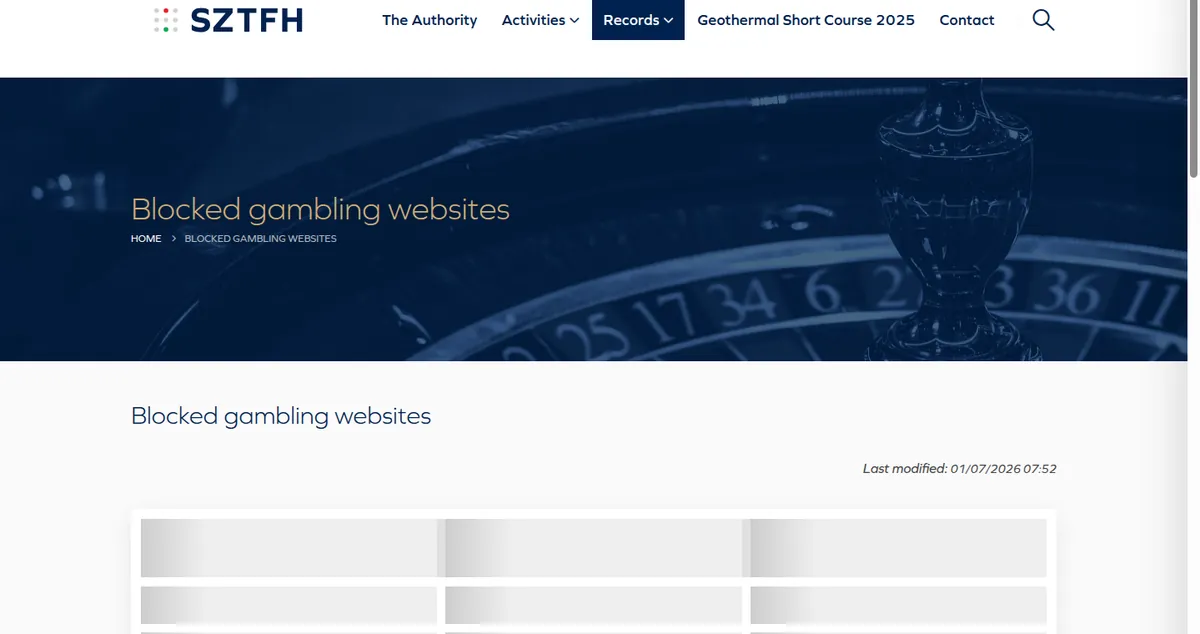
Throughout the szerencsejáték törvény, the penalties are addressed to whoever organises, intermediates or advertises the game. That covers restricting access to a website, prohibiting payment accounts, and advertising fines. Under section 2, the authority may impose on
„a reklámozót, a reklámszolgáltatót, a reklám közzétevőjét és a reklámban szereplő személyt egyetemlegesen … legalább 10 millió forint összegű közigazgatási bírsággal sújthatja”
— jointly and severally on the advertiser, the advertising service provider, the publisher of the advertisement and the person appearing in it, an administrative fine of at least 10 million forints.
Look at who is in that list. Advertiser, agency, publisher, and the person who appears in the advertisement.
The person playing is not among them.
The one prohibition on taking part, and it is not a penalty either
There is one place where the act does speak about participation. Section 1 (6):
„Játékkaszinóban és kártyateremben szervezett szerencsejátékban, valamint hírközlő eszköz és rendszer útján szervezett kaszinójátékban (a továbbiakban: online kaszinójáték) és távszerencsejátékban nem vehet részt az a személy, akit a bíróság a cselekvőképességét teljesen korlátozó gondnokság alá helyezett…”
A person whom a court has placed under guardianship fully restricting their capacity to act may not take part in a game of chance organised in a land casino or card room, in an online casino game, or in remote gambling.
That subsection is about people under full guardianship, and enforcing it is the organiser’s job: it has to screen those people out.
It is not an offence, not a fine, and not a penalty applied to the player.
The petty offence that is permanently half-quoted
Anyone who reads that a Hungarian player can be punished has almost certainly seen section 191 of Act II of 2012 on petty offences somewhere, under the heading “Tiltott szerencsejáték”. Its two subsections in full:
„Aki közterületen vagy nyilvános helyen tiltott szerencsejátékot szervez, szabálysértést követ el.”
„Aki közterületen vagy nyilvános helyen tartott tiltott szerencsejátékban részt vesz, szabálysértést követ el.”
Whoever organises a prohibited game of chance in a public space or a public place commits a petty offence. The second subsection says the same of whoever takes part in such a game held there.
The second subsection genuinely does address the participant. But both begin with the same four words, and those four words fix a place: a public space, or premises open to the public.
That half-sentence is not decoration; it is the frame of the offence, and it lifts out everything that happens in a private dwelling. The section is about street card games, subways, games held in public premises. A website opened in your own flat on your own phone is neither a public space nor a public place.
The heading of a section and the text of a section are two different things
Above section 191 stands the heading “Tiltott szerencsejáték” — prohibited gambling. In most Hungarian summaries that heading turns up as though it were a quotation, and on its own it does sound alarming.
But a heading is not a norm. It says what the section is about, not what constitutes an offence. The offence is defined by the two subsections, and both open with the same condition tied to a place.
So anyone quoting the heading instead of the text is passing off a line from a table of contents as a legal provision.
That difference matters elsewhere too. The third column of the authority’s register of blocked websites also uses the phrase “tiltott szerencsejáték szervezést megvalósító” — carrying out the organisation of prohibited gambling. The same expression therefore appears in two places in two different roles: once as a column header in a register, once as the heading of a petty offence.
We have not read the statutory definition of the expression itself, so we give none here. What can be read out of the texts is this much: liability for the petty offence has a further condition under both subsections of section 191, and that condition is the place.
Organising and taking part: what separates the two subsections
The section has two subsections, and they concern two different kinds of conduct.
The first has organising as its subject: whoever organises a prohibited game in one of the two locations above commits the offence.
The second has participation: playing in a prohibited game held in those same two locations is likewise an offence.
The legal weight of the two obviously differs, but the condition tied to place stands in both, in the same form. The legislator did not forget it for the participant: it is written in exactly the same way.
That is worth knowing when someone argues that a restriction on the organiser does not extend to the player. In the text it works the other way round: the frame extends to both, and the second subsection makes participation an offence only inside that frame.
Notice also what appears in neither subsection. No website, no service provider, and nothing about which country granted the organiser’s authorisation.
Why dropping those four words is no accident
When a page cites the existence of section 191 to claim that a Hungarian player commits an offence, it is dropping precisely the half of the provision that defines its scope.
Cutting four words out of a quotation is not a misunderstanding. It is an editorial decision.
In most places that sentence also sits on a page which then recommends a “safe” alternative. The fear-based opening and the recommendation that follows live in the same text, and the two are connected.
Checking it takes half a minute: the text of the section is public, and the two subsections are short enough to fit inside a single quoted paragraph.
How to spot a truncated quotation
Three signs give it away, and all three are recognisable while reading.
The first is where the quotation starts. Both subsections of section 191 begin with the word „Aki”, and the next four words concern the place. If a quotation starts at „tiltott szerencsejátékban részt vesz”, the front of the sentence has been cut off.
The second is the missing section number. Where the writer does not say which section of which act they are discussing, the claim cannot be checked — and usually the reason is that the writer never opened it either.
The third is what follows. A paragraph like that is nearly always succeeded by the recommendation of a “safe” alternative, and the order is not accidental: fear first, then the solution.
Two separate systems, two separate words for punishment
The two acts do not operate in the same system, and their vocabulary shows it.
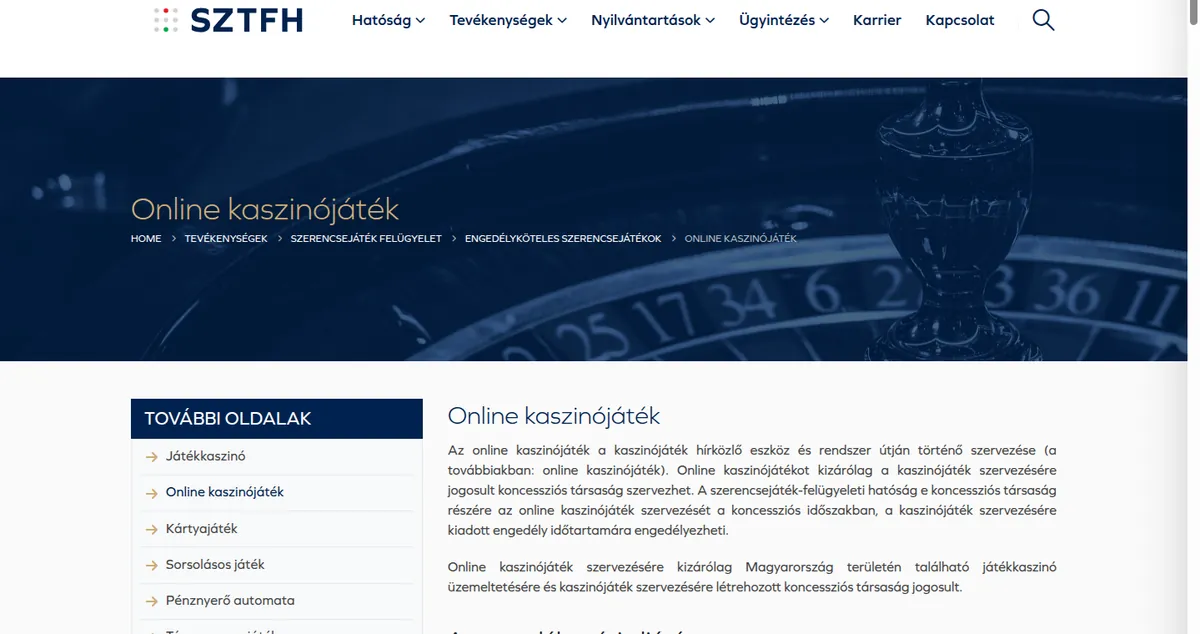
Section 2 of the szerencsejáték törvény speaks of a „közigazgatási bírság”, an administrative fine — an instrument the authority imposes in its own procedure. Section 191 of the petty offences act, by contrast, defines an offence: it says what constitutes a szabálysértés.
Melting the two together is convenient because one of them contains a large number and the other contains the phrase “takes part”. Put those side by side and you get a sentence that appears in neither source.
The authority’s register points the same way
The columns of the blocked-websites list hold a domain, an organisation name and a bank account. There is no field for a natural person playing, and the two other instruments alongside it are also addressed to service providers: the internet service provider and the payment service provider.
So the wording of the legislation and the authority’s practical toolkit point in the same direction. What the three instruments consist of is taken apart on a separate page.
Four questions for any legal claim about the player
If you read something about punishment in this area, four questions will tell you what the claim is worth. None of them needs a law degree.
Which section of which act? Without a name and a section number the claim cannot be checked. Two acts are in play, and they do not say the same thing.
Is the quotation complete? Look at whether the sentence starts with „Aki” and whether the next four words are there. If the quotation starts in the middle, the frame is missing from it.
Who is named as the addressee of the penalty? The penalty sentences of the gambling act name the organiser, the intermediary the agency and the publisher. If a claim says the fine applies to the player, check which list it is drawing on.
What comes next in the text? If the legal part is immediately followed by the recommendation of a “safe” site, the paragraph is not informing you; it is preparing you.
The four together take no more than five minutes, and they filter out a large part of what Hungarian search results return on this question.
How to check the wording of the legislation yourself
The consolidated text of the szerencsejáték törvény lives in the Nemzeti Jogszabálytár, the national legislation database, and carries the state as of 1 January 2026.
The choice of address matters here. A link in the form njt.jog.gov.hu/jogszabaly/1991-34-00-00 returns the text, while the shorter njt.hu form gives a blank page without a browser plug-in, because it loads the content afterwards. Anyone who hits the latter once easily concludes that the act is unavailable.
The petty offences act opens the same way, and section 191 can be found by searching for the section number. Two minutes, and afterwards you no longer have to take our word for it.
What the same structure costs
So far this page has been about what does not reach the player. But the same arrangement has a consequence worth saying out loud, because it is not a pleasant one.
Hungarian regulation gets hold of the organiser. Where there is no Hungarian organiser, the Hungarian instruments do not work either — and that is true not only of the penalties but of the protection.
If you end up in a dispute about money with a site that holds no concession, there is no domestic forum that can order the operator to do anything. The authority’s instruments are addressed to service providers: the internet provider, the payment provider, the parties in the advertising chain. None of them governs the settlement between you and the operator.
What remains is the operator’s own complaints handling, and after that the procedure of the jurisdiction that issued its authorisation, in a foreign language and on its own deadlines.
Both statements are true together. The act does not punish the player, and the same act does not protect them either where there is no Hungarian permit holder. Telling only one half of that is as much a half-truth as leaving four words out of section 191.
It follows that the centre of gravity of the decision is not the legislation but the contract. That is the thing worth reading, and the two points where the money passes through are set out operator by operator.
What you will not find on this page
We do not describe the criminal consequences of organising gambling without a permit, because we have not opened the relevant section of the criminal code. Numbers and prison terms on that subject can be read elsewhere; you will not get them from us until we have read it.
Nor do we describe how a restricted site might be reached anyway. Not in any form.
Finally: this page quotes legislation, but it is not legal advice. A specific case is answered by a lawyer, not by a website.
What to take away
That the question “is it legal or not” is two separate questions.
One is the authorisation to organise, and the wording of the concession answers it: three websites stand on the Hungarian permit list, and the rest of the sites sit outside it. The player’s position is the other, and the four words above are the answer to that.
Anyone who wants to do more for their own safety should not be reading legislation but a contract: above all the clause on payouts and identity checks. And anyone whose play has already become a problem will find the useful number on the page about the Hungarian helplines.