
A foreign online casino got its authorisation somewhere else
Nine numbers that can be looked up
In Hungarian usage a foreign online casino is a site working without a Hungarian concession, under the authorisation of another jurisdiction. Our table lists 10 such sites; 9 of them publish a number that can be found in the issuer’s register, and all 9 also state which countries they will not take players from.
The phrase is about where the authorisation sits, and about nothing else. The Hungarian authority’s permit list holds 3 websites, and none of the ten sites above is among them: their entries are in Curaçao or in Anjouan.
Three separate questions follow from that. Where the entry sits, what the contract says about the Hungarian player, and what it says about paying money out.
Most Hungarian-language summaries melt those three into a single star rating, and from there they cannot be taken apart again. Here they stand separately.
Two of these three documents are in English
If you live in Hungary and work in English, this page is the easiest of the set to verify yourself. The Curaçao and Anjouan registers publish in English, and so do the operator terms.
Only the Hungarian side — the permit list, the blocking register, the act — stays in Hungarian. So the check that decides most of what matters here is one you can run in a language you read, on public pages, without asking anyone.
Ten casinos with no Hungarian concession. Licence numbers come from the issuing register, everything else from the operator’s own terms as read on 26 August 2026. An empty cell means we could not read the figure out — never that it is zero, and never that there is no limit.
- Rocketpot
-
- LicenceCuracao
- CompanyDanneskjold Ventures B.V.
- Before ID is askedUS$2,500
- Bitcasino.io
-
- LicenceCuraçao Gaming Authority
- CompanyMoon Technologies B.V.
- Before ID is asked2,500 EUR
- Wild Fortune
-
- LicenceAnjouan Gaming Board
- CompanyMetlait SRL
- Before ID is askedcase by case
- DuckDice
-
- LicenceAnjouan Gaming Board
- CompanyZentari Limitada
- Before ID is askedcase by case
- Empire.io
-
- LicenceAnjouan Gaming Board
- CompanyPixel Entertainment Limited
- Before ID is asked2,000 USDT
- Metaspins
-
- LicenceCuraçao Gaming Authority
- CompanyMetaspins N.V.
- Before ID is askedcase by case
- Rainbet
-
- LicenceAnjouan Gaming Board
- CompanyRBGAMING N.V.
- Before ID is askedcase by case
- Shuffle
-
- LicenceCuraçao Gaming Authority
- CompanyNatural Nine B.V.
- Before ID is askedcase by case
- Wild.io
-
- LicenceCuraçao Gaming Authority
- CompanyNonce Gaming B.V.
- Before ID is askedcase by case


What the word “foreign” does and does not mean
It does not mean operating without any authorisation. Nine of the ten have a number, and that number appears in the issuer’s register.
Nor does it mean having a Hungarian authorisation. The authority’s register of authentic permits carries only three websites, under a single organiser.
The real question lies between the two: what the entry is worth if a dispute arises. The sections below answer that, number by number.
Three number formats, three registers
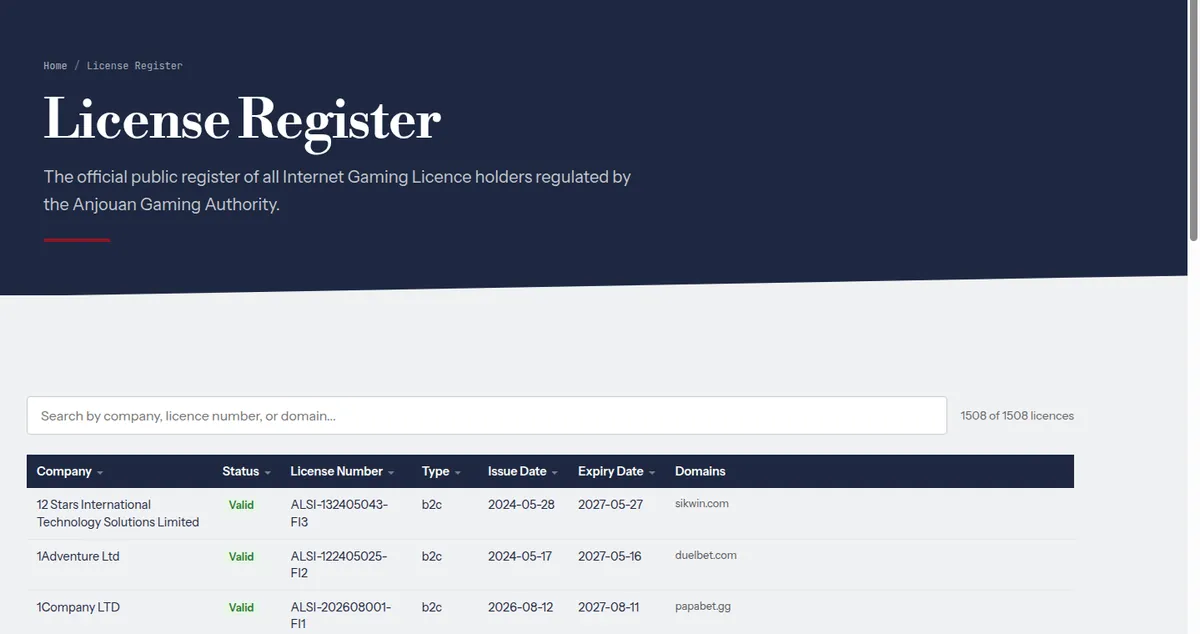
Curaçao OGL number. Four operators publish one, and all four entries showed a status of “Active” in the register:
- Bitcasino.io — OGL/2023/111/0069
- Metaspins — OGL/2024/1063/0437
- Shuffle — OGL/2024/1337/0628
- Wild.io — OGL/2024/210/0198
Anjouan ALSI number. Four operators again, and all four entries stood as valid in the public licence register:
- Wild Fortune — ALSI-202509073-FI2
- DuckDice — ALSI-202509013-FI1
- Empire.io — ALSI-132405042-FI3
- Rainbet — ALSI-152406029-FI2
The older Curaçao format. Rocketpot gives 1668/JAZ, with Danneskjold Ventures B.V. behind it. For that entry we could not read the status field, so it stands empty in the table rather than carrying the word “valid”.
For the tenth site we hold no number. That does not mean it has none: it means we did not read one out.
How to look a number up yourself
The two issuers’ registers are built differently, and that difference decides how hard the check is.
The Curaçao authority issues a separate address per certificate. So a specific certificate can be opened, but there is no results list that can be paged through by brand name, and that makes it substantially harder to establish which entry sits behind a given domain. We kept the four certificate addresses as sources.
The Anjouan board, by contrast, keeps a single public register in which the marks stand one after another. That is where we looked up the four ALSI numbers, as read on 26 August 2026.
In both cases the same three steps get you there.
Open the site’s footer and find the line referring to the authorisation. If there is only a logo and no number, the logo is a picture, not evidence.
If there is a number, look it up in the issuer’s register, and check the entry’s status field too, because that is what tells you whether the authorisation is alive on the day you look.
Finally, compare the company name in the register with the one named in the footer. The company column of our table holds exactly that name: we could read it for nine operators, and not for one.
Why a Curaçao number is harder work than an Anjouan one
The structures of the two registers differ, and how much work looking a mark up takes follows from that.
In the Anjouan register the marks stand one after another on a single public page. Someone who knows the number finds it; someone who knows only the brand name reads through the list, and usually finds it that way too.
On the Curaçao side each certificate has its own address. That means the page belonging to a specific mark can be opened, but there is no results list to page through by brand name. So anyone who only knows the domain has to extract the number from the operator’s footer first, and can only check it afterwards.
That has an uncomfortable consequence. The footer is the operator’s own text, so the first step of a Curaçao check uses data written by the party being checked. The Anjouan register makes that step skippable, because the listing itself can be read.
Which is why we printed all nine marks out by number. Anyone starting here does not have the operator’s footer as their source for the first step.
The issuer does not determine the contract
The most common shortcut is to infer from the name of the jurisdiction how an operator will behave. Our own ten rows do not support that.
Four of the sites in our table work on a Curaçao OGL mark. One of them writes a specific identity threshold into its terms; the other three leave it to their own judgement.
Four of the sites in our table work on an Anjouan ALSI mark. Here too, one writes a figure down and three do not.
The picture is the same at the payout ceiling. Of the four Curaçao sites we found a figure at two, of the four Anjouan sites at one, and the ninth site, on the older-format mark, publishes a ceiling as well. Nor do the figures follow the jurisdiction in magnitude or in period: weekly and monthly limits are mixed in both groups.
So where the entry sits reveals nothing about the content of the contract. What has to be read is the same two clauses every time, and both, with clause numbers, are printed page by page.
What a valid number does not prove
Not a Hungarian authorisation. No Curaçao or Anjouan entry turns into a Hungarian online casino authorisation, because the szerencsejáték törvény ties that to a domestic casino concession.
Not a payout. An authorisation is not a contract with the player. The movement of money is governed by the withdrawal clause of the operator’s own terms, and far more specific figures stand there.
Not a verification practice. Two sites under the same jurisdiction describe when they ask for documents in completely different ways. Of the four sites in our table on an OGL number, one writes a specific threshold into its terms and three do not, even though the same body granted their authorisation. The clause numbers are on the page about identity checks and payouts.
Not acceptance of a Hungarian player. That is stated by the operator’s own country list, and that is a different part of the document.
When the footer holds a logo but no number
That is our tenth case, and the most common situation from a reader’s point of view.
A logo referring to an authorisation is a picture. A picture cannot be looked up, it has no status field, and it does not say which company the entry is in the name of. An emblem at the bottom of a footer does not become register data by being there.
Three places are left where a number might be. One is the small print beside the logo. Another is the opening paragraphs of the general terms, where the contracting party’s name and registration are given. The third is a separate policy on responsible gaming or anti-money-laundering procedure.
If there is none in any of them, the position is this: the site publishes no mark a register could confirm. That is not the same as having none, and it is not the same as having one.
That is exactly how we record it. In one of our rows the licence number field is empty, because we could not read the site’s text out, and it stays empty until we can.
The archived copy
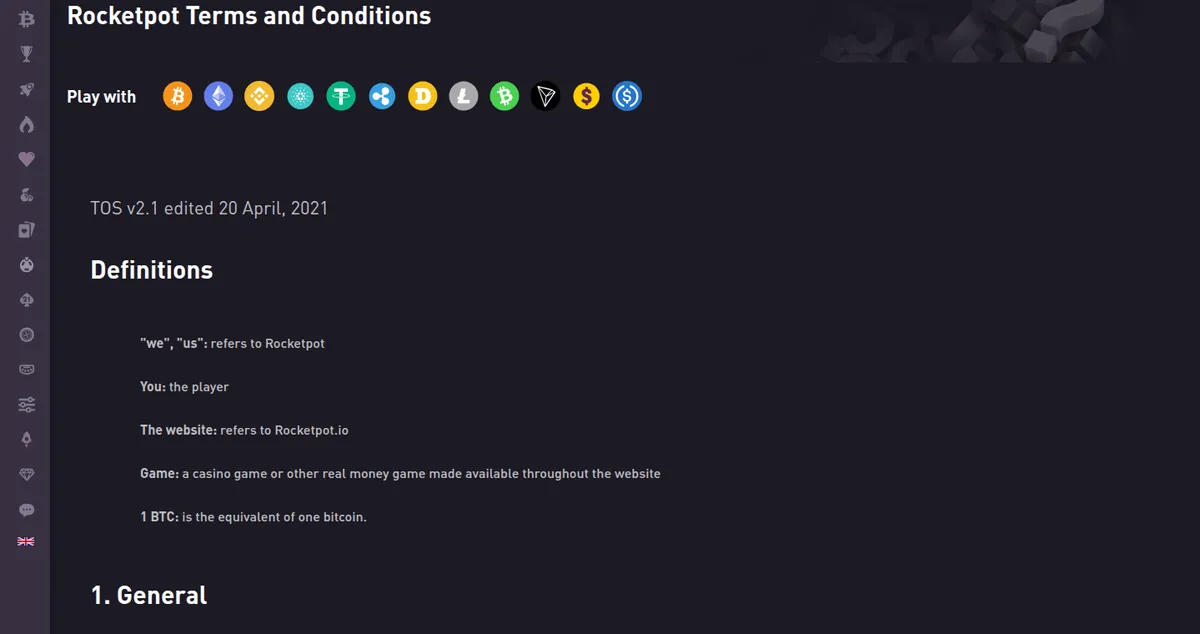
We did not read the Empire.io terms from the live site but from an archived copy. The number and the clause cited come from there, and we record it that way here and in the table.
That looks like a small point and is not. An archived copy shows what stood in the text at the moment the copy was taken. If the operator has rewritten it since, the copy cannot tell you.
Which is why we say where it came from.
Do they take Hungarian players at all
That is decided by the operator’s own terms, not by any Hungarian official intent. We read 38 country lists in total, and Hungary appears in nine:
- 7Bit Casino
- BitStarz
- Bitdreams
- Mirax
- Oshi Casino
- PlayAmo
- Slotum
- Winz.io
- Bitkingz
None of these is in the table above, and not by accident: an operator whose own contract says it does not want Hungarian players drops out of the selection.
The consequence in that case does not show up at registration. Opening an account often runs through without trouble, the deposit arrives too, and the country list comes up when the money would start moving out.
We read that paragraph for nine of our ten sites, and Hungary appears in none of them. At the tenth we could not read the terms out, so we make no such claim about it.
Why thirty-eight lists when there are ten sites
Because the table is the result of a filter, not of a ranking.
We read the country lists of thirty-eight operators. Hungary appears in nine, and those nine dropped out for that reason: listing an operator that excludes Hungarian players in its own contract would be misleading here, however well known the brand.
So the reason for dropping out is not a quality judgement. One part of one document decided it, and that part of the document belongs to the operator.
The ten rows came out of what was left. At nine we read this paragraph and Hungary appears in none of them; at the tenth we could not open the terms, so we make no such claim about it and its field stands empty in the table.
That distinction is the point. “Hungary is not in it” and “we did not read the list” are two separate sentences, and the second can never be converted into the first.
What the length of a country list tells you
The nine lists vary greatly in size:
| Operator | Countries excluded |
|---|---|
| Metaspins | 58 |
| Wild Fortune | 47 |
| Wild.io | 45 |
| Rocketpot | 34 |
| DuckDice | 16 |
| Shuffle | 15 |
| Empire.io | 12 |
| Rainbet | 11 |
| Bitcasino.io | 1 |
A list of 58 items shows that the operator thought through and wrote out where it does not want to operate. A list containing one country, on the other hand, does not mean everyone else is accepted: it means that is how much is published.
The difference matters in a dispute. Where the list is long and itemised, the absence of Hungary is a strong argument. Where there is a single line, the same argument is much weaker, because the document simply says very little.
Where to look for this paragraph in the contract
Search for “restricted” or “prohibited” and look at the list around the hit. The country list is nearly always itemised rather than running text, and in most sets of terms it sits much further back than you would look.
Search for the name of the country as well, and separately for the two-letter code.
Several contracts work with country codes, and anyone searching only for the full name finds nothing in that case, even though it is there.
Check the date or version of the document, where there is one. Country lists change, and our reading records the state of 26 August 2026.
What the Hungarian rule says about this situation
Section 3 (1b) of the szerencsejáték törvény narrows the organiser:
„Online kaszinójátékot kizárólag a Magyarország területén található játékkaszinó üzemeltetésére szóló koncesszió jogosultja által a kaszinójáték szervezésére létrehozott vagy működtetett koncessziós társaság szervezhet.”
So a foreign company has no application by which it could get in. What can happen to it is restriction: the authority may initiate the restriction of access to the website, the prohibition of its payment account, and the blocking of its advertising. Those three instruments work separately, and each is addressed to a service provider.
The act prescribes no penalty for the player. The only petty offence provision applies to a game held in a public space or a public place, and we have set its text out in full.