
A no-deposit bonus is decided by two clauses in the contract
Bonus terms and withdrawals
A no-deposit casino bonus becomes valuable or worthless depending on whether the winnings can be paid out. That is settled by 2 clauses in the contract, and both of them sit outside the bonus text; the third thing worth knowing is why no offer of this kind is advertised to the Hungarian public at large.
A no-deposit bonus is a small amount of play money or a handful of free spins that you do not have to transfer anything for. The size of the offer is printed everywhere; the 2 other numbers that go with it rarely are.
The first is the identity threshold: at what amount the operator asks for documents. The second is the payout ceiling: how much can leave the account in a given period.
Bonus winnings pass through both before they turn into money.
What you will and will not find here about bonus terms
The bonus amount was read at none of the ten operators, and neither was the maximum withdrawal expressed against a bonus. Neither figure appears here.
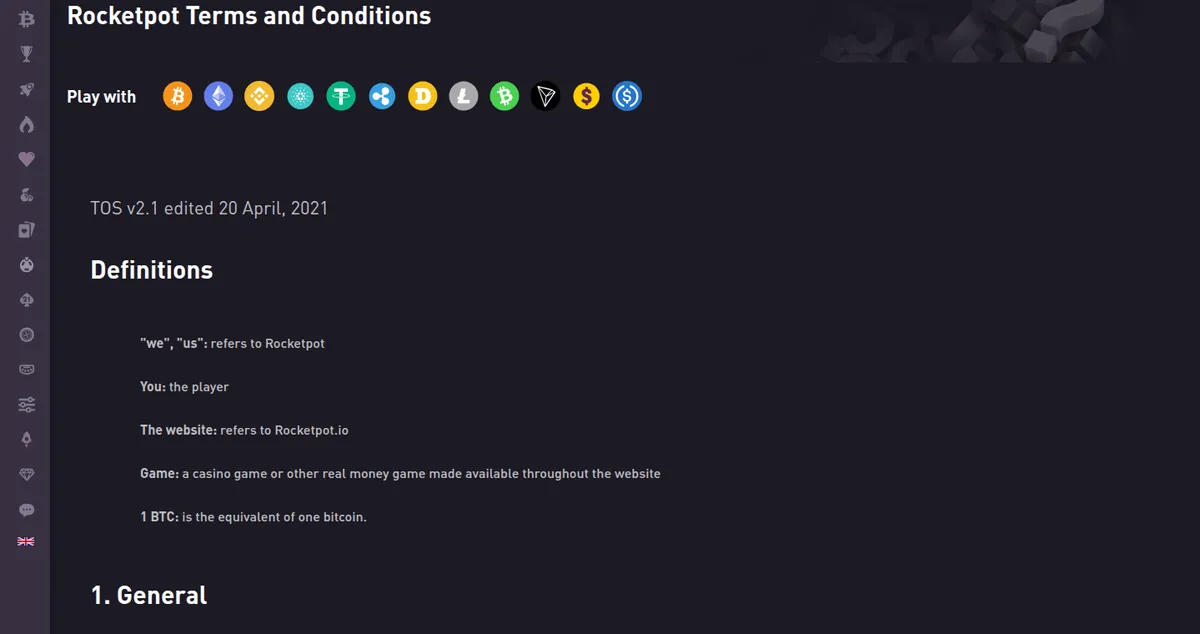
The wagering requirement is the one clause of the family that was read, at four of the ten and always on a deposit offer. Clause 9 of the Rocketpot bonus terms writes 100x unless an individual offer says otherwise, with clauses 11, 12 and 13 counting the house’s own games at a tenth and table games, live tables, video poker and sport at nothing. Bitcasino.io writes 30x on the bonus money alone, with a seven-day deadline, a 4 USDT maximum stake and a 50 USDT minimum deposit. Rainbet writes 40x on deposit and bonus together. Wild.io stands at 40x. Only Rocketpot’s figure carries a clause number; the other three sit in the operators’ own promotional text, read on 2 September 2026, and that is said here rather than glossed over. At the remaining six the field is empty, and empty means unread.
A number on its own says nothing.
An empty field here means what it means everywhere else on this site: we did not look. Never that it is zero, and never that there is no limit. Our methodology page applies the same rule to every field.
It is worth adding why this particular figure was left out. In the nine sets of terms we read, we were looking for two clauses specifically: the one on verification and the one on withdrawals. Bonus terms often live in a separate document that the general text merely refers to, and we did not open that separate document.
The bonus amount is also the easiest number in the whole subject to invent. It is round, it sounds good, and afterwards nobody can tell a figure that was read from one that was estimated. Which is why there is not a single one of them here.
The first gate: verification
We read nine sets of terms with verification in mind. Three carry a specific threshold: $2,500, €2,500 and 2,000 USDT. Those thresholds do not apply to the bonus; they apply to all traffic on the account.
Six operators write no figure and instead authorise themselves to request documents at any time.
The clause numbers are listed operator by operator on the page about identity checks and payouts.
The second gate: the payout ceiling
Four operators write a ceiling into their terms. $5,000 a month, 1,000,000 USDT a week, €15,000 a month and $100,000 a week appear under four different clause numbers.
In four contracts we found no such figure, and at one we could not read the text out at all.
A missing figure is not an advantage: a withdrawal does not become unlimited because nobody wrote a limit down. In a fifth contract there is even a clause on withdrawal limits with no amount in it, which shows neatly how different the question “is there a rule” is from the question “how big is it”.
“No deposit bonus” is not the phrase in the contract
Whatever the campaign page calls it, the contract almost never uses the same words.
The operator’s text speaks about it in English, and the terms worth searching for are “no deposit” and “bonus”. The Hungarian name belongs to the campaign page and the advertisement, not to the terms.
That has a practical consequence. Anyone searching the terms for the Hungarian phrase typically finds nothing, and draws the false conclusion that no separate rule applies to the offer. There is one; it is under a different name.
The same goes for hunting for a difference between the various Hungarian and English phrasings. These are not different products, only different word orders, and none of them affects the payout.
The order in which the four numbers act on one another
The four figures do not come into force simultaneously but one after another, and that order decides how much is left at the end.
The wagering requirement first. Until it is met, the bonus does not turn into withdrawable money, so none of the other numbers matters yet. This is the clause we did read, at four of the ten: 100x, 40x, 40x and 30x, on three different bases.
Then the cap that applies to the bonus. This is the separate upper limit set on bonus winnings, and of the four numbers it is usually the smallest.
Then the account’s general payout ceiling. We read this out at four of the sites in our table, and the four figures cover two monthly and two weekly limits in three currencies. Under a monthly limit a payout can stretch across months; under a weekly one the same amount can be out much faster.
Finally verification. This does not cut an amount, it costs time: documents have to be submitted, and exactly one of the contracts sets a deadline for that, thirty calendar days.
So anyone looking only at the size of the bonus is not even seeing the first of the four steps.
Why discretion is most likely to kick in here
Because at a no-deposit offer there is no deposit of the player’s own on the account.
The operator would be paying out money against which the player has made no transfer at all, and most of the contracts reserve their free hand on documents for exactly that case. At two sites the discretion does not even wait: one requires players using bitcoin to submit a valid document before play begins, and the other ties verification to opening the account.
So a bonus is not a relaxation of the entry requirements. It is the point at which verification can come up earliest.
Why Hungarian-language bonus advertising is rare
There is a legal reason, and it can be read in section 2 of the szerencsejáték törvény, the Hungarian gambling act. The act penalises the parties on the advertising side together:
„a reklámozót, a reklámszolgáltatót, a reklám közzétevőjét és a reklámban szereplő személyt egyetemlegesen … legalább 10 millió forint összegű közigazgatási bírsággal sújthatja”
The addressee of the fine here is not the player but the advertising chain: the advertiser, the advertising service provider, the publisher, and the person who appears in the advertisement.
That is why the Hungarian internet carries essentially no mass-audience campaign for a no-deposit offer from a site without a concession, and why it is worth looking at who is behind an advertisement that does turn up.
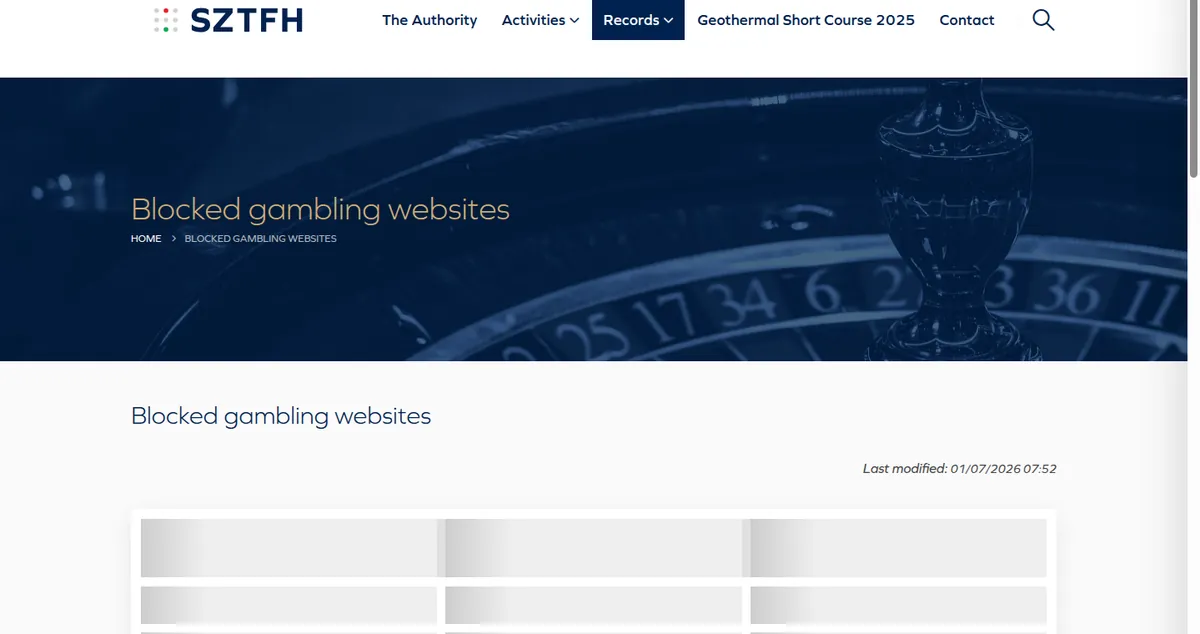
The authority also keeps a separate register of blocked advertising sites. We did not open that list, so we claim nothing about its contents. How the three restriction instruments relate to one another is set out on its own page.
What the advertising rule does to the offer
Section 2 does not prohibit the offer; it prohibits advertising it publicly, and the fine can be imposed on the whole advertising chain. That has a visible consequence for where a reader in Hungary meets it.
In large-format, television or outdoor advertising, an offer of this kind essentially never appears. What remains is the narrower channel: the operator’s own site, a mailing list, and a partner link.
None of that makes the offer better or worse. It means one thing: it typically reaches a reader in Hungary not through an advertising slot but through somebody’s recommendation, and at that point it is worth looking at who that somebody is.
This page has an outbound button too, marked as an advertisement, and the link to it carries a sponsored attribute. That marking is for the search engine and the reader alike, and it changes none of the four numbers above.
Where the bonus clause sits in the contract
Not where the offer is.
The size of the bonus and the promise attached to it are published on the landing page or a campaign page, while the rules that decide the payout stand in the general terms, often in a separate bonus policy that the general text merely refers to.
That is why one question can require two documents to be opened. One says how much you get; the other says how much can come out of it.
Where a campaign page cites no clause number, the promise cannot be checked. That does not mean it is untrue: it means there is nothing to measure it against.
What the bonus terms cannot override
Not the account’s general payout ceiling.
If the contract sets a weekly or monthly upper limit on withdrawals, it applies to money originating from a bonus exactly as it applies to money played from your own funds. We read that figure out at four of the sites in our table, and the four values are not in the same order of magnitude: they run from $5,000 a month to 1,000,000 USDT a week.
Not the verification clause either. That does not apply to the bonus but to all traffic on the account, and the three thresholds we read out are worded that way.
So the bonus terms are not the contract’s strongest layer but its outermost one. Underneath sit two clauses that govern the actual route the money takes, and they work regardless of what the bonus text says.
Nor the country list. If the operator’s own terms exclude the player’s country, a bonus changes nothing about that, and the realisation typically arrives at the same place as the effect of the other two clauses: at the payout.
What to check in the bonus terms yourself
Four sentences are worth finding in the text, and each has a clause number.
The wagering requirement. What multiple of turnover makes the bonus withdrawable, and whether stakes played from your own money count towards it.
The maximum withdrawal against the bonus. Many contracts give a separate ceiling for winnings from a no-deposit offer, and it tends to be lower than the general one.
The excluded games. The terms often name games in which stakes do not count towards the wagering.
The verification clause. This decides whether the operator asks for documents before paying out.
That order matters. The wagering requirement sets when the bonus becomes withdrawable money at all; the other three set how much of it gets out.
Four questions for the promise on a campaign page
An offer is worth judging by how much of the promise can be traced back to a source, rather than by its size. Four questions are enough.
Does it cite a clause number? If the campaign page says which clause the detailed condition sits under, the promise can be checked. If not, there is no link between the copy and the rule.
Is there a date or a version on it? Bonus policies change, and there is no way to say when an undated promise was valid.
Does it name the separate bonus policy? The sentences that decide the payout are typically not on the campaign page. If the offer does not say where to look for them, the search is left to the reader.
Does it say who it does not apply to? The country list and the verification condition operate at a bonus too. An offer that only talks about who can receive it is giving you half the information.
None of the four needs expertise, and all four can be answered by reading the text. If three answers come back negative, the offer is not bad — it is unverifiable, and those are not the same thing.
What matters besides the bonus
A site’s authorisation is not written in its bonus. Three websites appear on the Hungarian authority’s permit list; everything else operates on a foreign authorisation.
We have broken the other measurable aspects of the choice into six questions. The bonus is not among those six, because only one of its four figures was read, and only at four of the ten.
Why there is no “best bonus” list here
Because making one would mean comparing four figures per operator: the size of the bonus, the wagering requirement, the maximum withdrawal against the bonus, and the set of excluded games. Of those four we hold one, at four operators of ten, and the four figures do not share a base — 30x on the bonus alone and 40x on deposit and bonus together are not the same demand.
What we hold besides that is the two general clauses, and they apply to bonus winnings just the same. But those two cannot support a ranking: neither is about the size of the offer, only about how much of it gets out at the end.
A “best bonus” list here would therefore be built either from incomplete data or from estimates. The second is worse, because it does not look like an estimate.