
Source, date, empty field, and correction in public
Method
This site reads documents: legislative text, official registers and operator terms. The operator data come from a reading of 26 August 2026, the legal citations from the consolidated text in force on 1 January 2026, and the list below also says what we did not open.
We work from four types of source, and all 4 are public, so anybody can check them.
Which sources are in which language
Two of the four are Hungarian-only and two are in English, and that split shapes what an English-reading reader can verify without help.
The legislation and the official registers are published in Hungarian, with no official translation. Where we quote them, the Hungarian stands in the text with an English rendering beside it, so the string you would search for is on the page.
The licence registers and the operator terms are in English. Those are the sources you can open and read end to end yourself, and they are also the ones that decide what happens to your money.
The four sources
Legislative text. The consolidated texts in force of Act XXXIV of 1991 on the organisation of games of chance and Act II of 2012 on petty offences. Where we quote a section, we quote it word for word and print the section number.
Official registers. The register of authentic permits of the Szabályozott Tevékenységek Felügyeleti Hatósága, the register of blocked websites, and the authority’s own information pages. We always print the date of the reading beside these, because they are live pages carrying timestamps.
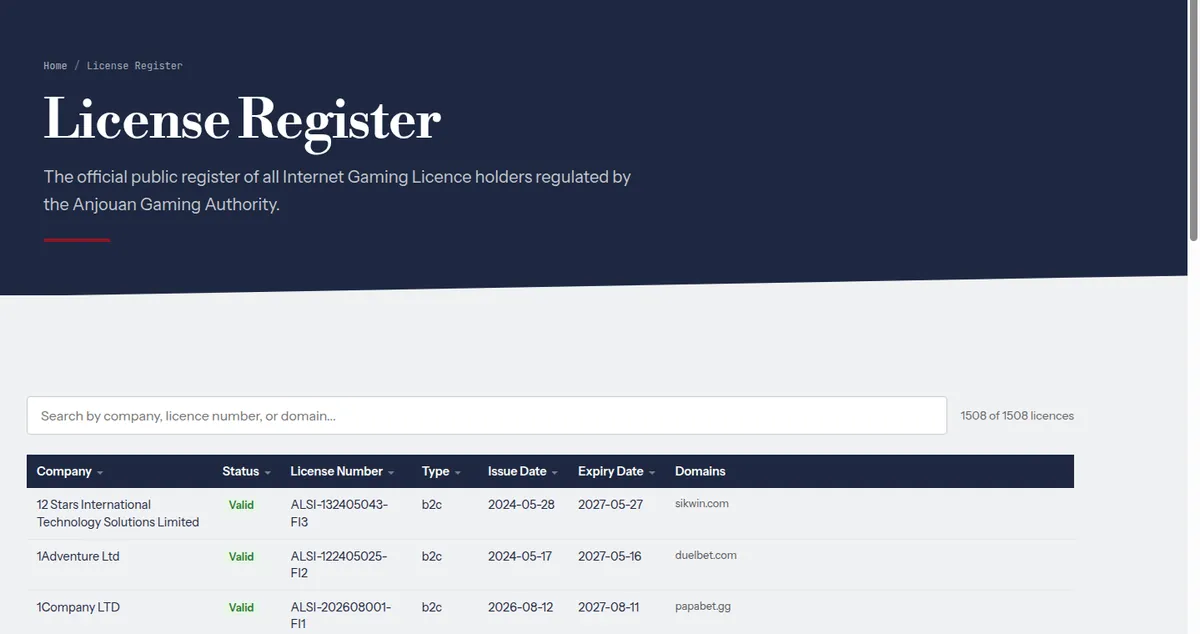
Licence registers. The Curaçao certificates and the Anjouan public licence register. The numbers and statuses come from there, not from the operator’s own footer. What an entry of that kind proves is set out on its own page.
The operators’ own terms. This is where the identity threshold, the payout ceiling, the country list and the clause number they all sit under come from.
What an empty field means
It means we did not read it out. Nothing else.
Not that it is zero. Not that there is no limit. Not that there are no identity checks.
An unread payout ceiling turns into “unlimited withdrawals” the moment someone sells the gap as an advantage, and that is exactly the move by which missing data becomes marketing. Which is why one row of the table is empty in several places: at that site we could not read the terms out, and we do not plug the gap with an estimate or a generalisation.
Live reading and archived copy
The two are not the same, and we distinguish them.
At nine operators we read the terms from the live site. At one, Empire.io, from an archived copy, and the table records it that way.
An archived copy shows what stood in the text at the moment the copy was made. If the operator has rewritten it since, the copy cannot tell you, so we do not lump it in with the rest.
Four dates every claim belongs to
Not one of our figures is undated, and the four days belong to different groups of source.
26 August 2026. On this day we read out the licence entries and terms of the ten operators. Every contractual figure comes from here: the identity thresholds, the payout ceilings, the clause numbers and the country lists.
31 August 2026. This is the timestamp of the register of blocked websites itself, not the day of our reading. The serial number 6,403 at the top of the list belongs to that stamp.
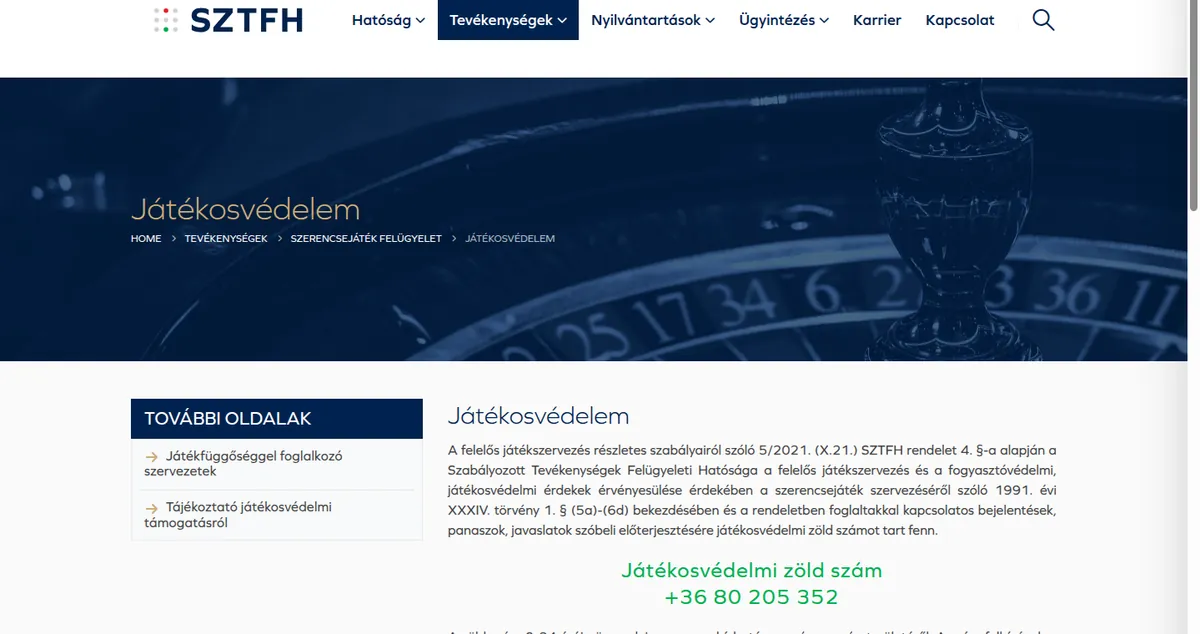
1 September 2026. This is when we opened the authority’s register of authentic permits and its information pages on online casino games and player protection. The three permitted websites, the difference between the two tabs and the description of the freephone line come from here.
2 September 2026. On this day we tried, and failed, to read out our advertising partner’s terms.
The legal citations run separately from all of this: they come from the consolidated text in force on 1 January 2026, and everywhere they stand with the section number.
The advertiser’s row, and what we do not write into it
The first row of the table belongs to our advertising partner, and its fields are empty.
That row is the best example of how the rule works here. The site’s text is drawn by a script, our reading did not wait for it to appear, so we have nothing to quote. That did not make its right to appear in the list any smaller or any larger.
The easiest thing to do would be to fill the advertiser’s row with the average of the other nine, or with a “typical” value. That move would do precisely what the whole method exists to prevent: it would manufacture confident data out of missing data, and at the very row where our own interest is greatest.
So it stays empty, and the reason is written under the table.
The same holds in reverse. We do not write that the advertiser is worse than the others, because we do not know that either: missing data is not incriminating evidence, only missing data.
If we get it wrong
We expect to be wrong sooner or later. A contract clause gets renumbered, a row disappears from a register, a date gets mistyped.
When that happens, the correction is not made quietly. The home page carries a section on what has changed since the last check, and a correction goes into the same place, with its date.
That matters because a silent rewrite has the same effect as a missing source: the reader cannot tell it from what was there all along. If a figure changes, the difference between the old and the new is itself information, particularly where an operator has rewritten its own terms.
What we do not do: we do not delete a sentence because it has become inconvenient, and we do not swap a figure we read out for one we did not take from the source.
What we never write
We never write that we tried it. We hold an account with no operator, we have paid in nothing, and we have requested no withdrawal. Every figure comes from a document, not from our experience.
We give no star rating and no ranking. The order of the table on the home page is not a quality ranking; it follows the amount of data we could read out. What can be settled instead of a ranking is broken into six questions.
We give no technical advice. These pages do not discuss software, settings or devices, and we do not write about getting around a restriction in any form.
We use no urgency. No countdown, no “this many people are looking now”, no invented deadline.
Three things we do not accept as a source
Not everything readable counts as data, and three cases are worth naming separately.
The operator’s footer in place of the register. The mark and the company name in the footer are written there by the operator itself. Good as a starting point, not as evidence, which is why we always looked the numbers up in the issuer’s register.
Another comparison site’s table. If the source of a figure is a third website, the figure is worth what that website is worth, and it usually does not say where it got it. We copy nothing like that across.
Our own earlier reading with no date on it. A set of terms changes within weeks. If a figure has no day attached, we cannot say when it was true, so we do not claim it is true now.
What the three have in common is that all three are convenient. Which is exactly why they need saying out loud: most inaccuracy comes from convenience, not from malice.
How to check a claim after us
Every contractual figure here carries a clause number, and every official figure the date of the reading. From that, anyone can check in four steps.
Open the operator’s terms and search for the clause number you see here. If the figure is there, the claim is confirmed; if the clause is empty or has been renumbered, the contract has changed since our reading.
Open the official list and look at the timestamp at the foot of the page. If the stamp is later than the day of our reading, the content may differ too.
Look the mark up in the issuer’s register. The status field always shows the day you are looking, not the day we looked.
Finally, compare the legal quotations against the section number. The text in force is public, and the section number finds it in seconds.
What we did not read
This list is exactly as important as the list of sources.
We did not read Act XXXII of 2021 on the Szabályozott Tevékenységek Felügyeleti Hatósága, so we make no claim about how the authority was created or about its legal status.
We did not read the legislation that opened remote gambling, so we give no year for it. That the concession and the permit are two separate instruments, on the other hand, we read out of the text in force.
We did not open the registers of blocked advertising sites and prohibited payment accounts. All we write about them is that they exist; what we know about the third list is on its own page.
We did not read the gambling provisions of the criminal code, so we publish no penalty ranges anywhere. We did not open the relevant tax legislation either, so there is no figure here about tax on winnings.
At one operator we could not read the terms out at all. Several fields in that row of the table stay empty, and that is not an accidental omission but a consequence: if the source did not open, the data derived from it cannot go in. That same row is incomplete at the licence number, the identity threshold, the ceiling and the country list alike.
What we have no picture of
The screenshots are not decoration: each one supports a claim, and can therefore only be taken from a page we were able to open.
We have no such capture of the legislative text. The Nemzeti Jogszabálytár page stalled on an access question before the text appeared, so beside the legal quotations there is no image but the section number and the address at which anyone can look it up.
Equally, we have no pictures of the registers we did not open.
That decision is consistent. A capture of a page proves we looked at it; where there is no capture, either we did not look or the source did not give itself up, and both cases are better said than covered over with a plausible-looking image.
How a document becomes a table cell
The procedure is always the same, and it has four steps.
We find the clause in the contract that answers the question. We copy the figure out of it exactly as it stands, with the currency and the period. We note the clause number. Finally, we write the date of the reading beside it.
There is no conversion. If the condition speaks of €2,500, it stays €2,500 here, because the operator will apply it in that currency, and an approximation in forints only manufactures the appearance of a precision that does not exist.
There is no merging either. The identity threshold and the payout ceiling sit in two separate clauses, often ten pages apart, and they go into separate columns here as well.
Why we print the clause number everywhere
Because a claim with a clause number can be checked in half a minute, and without one it cannot be checked at all.
Someone looking for Rocketpot’s clause 11.4 opens the terms, searches for the number, and the sentence is there. Someone who reads only that “they verify above $2,500” has to comb the whole text to find out whether it is true.
The clause number also shows where there is no data. The Metaspins terms have a clause on withdrawal limits, 12.5, but no amount in it: we read out the clause number and not the figure. Those two pieces of information differ, and we mark them separately.
When the footer and the register disagree
In that case the register counts.
The text in the operator’s footer is written by the operator; the entry in the issuer’s register is written by whoever granted the authorisation. That is why we always looked the numbers up in the register rather than copying them from the footer.
The same goes for the company name: the company column of the table holds the name we found in the register, and where it could not be read out, the field stays empty.
Why we do not round
We publish figures as they stand in the contract, without rounding, and there is a reason for that too.
A rounded threshold errs in the wrong direction in practice. Someone reading “around two and a half thousand” instead of $2,500 forms a range in their head, while the contract holds no range but a precise figure above which the condition engages.
The same is true of the period. “Monthly” and “weekly” are not stylistic variants: the same amount means a seven- or eightfold difference in the pace of a payout between the two.
And it is true of the currency. A dollar threshold and a euro threshold are not the same number even when they are close, because the operator will apply it in the one it wrote.
Advertising on this site
One row of the table and the foot of a few pages carry a button leading out, to an advertiser’s own site. Those links take the value sponsored in the rel attribute, so a search engine can see too that this is not an editorial link.
Advertising does not move the content of the text. A figure goes into the table if we read it out of a document, and that rule applies equally to every row.
If we were wrong
Write to us. We do not make corrections quietly: we replace the incorrect sentence and note what stood there before and when we changed it.
The commonest source of error is the date. An identity threshold or a payout ceiling can be rewritten by the operator at any time, and our reading belongs to a particular day. The same is true of the coin lists and of the clause numbers.
Country lists change too, and the timestamp on the official pages exists precisely so that our reading can be compared against a later state.