
Ten contracts, clause by clause, instead of online casino reviews
Ten operator pages
Most online casino reviews are accounts of somebody’s experience, and they very rarely say which contract clause the money got stuck on. The 10 pages below are the reverse: each starts from an operator’s own terms, with clause numbers, and each goes quiet where we did not read the text.
An account of an experience and a contract are 2 different genres. One is about what happened to somebody; the other is about what can happen to anybody.
This page works with the second, and each of the 10 operators has a page of its own.
The reviews you can read, and the ones you cannot
A reader in Hungary who does not read Hungarian is cut off from most of the local commentary on these operators — and from most of the misinformation in it, which is not entirely a loss.
What is lost is more useful than that, though: Hungarian-language complaints are where a Hungarian player’s specific trouble surfaces, and the country list, the currency and the payment rails are the parts a general English-language review is least likely to cover. The ten pages below are written to close that gap from the document side rather than the anecdote side.
What a complaint shows, and what it does not
A complaint is not evidence in itself. There is no way to know who wrote it, when, with what balance and after what history, and no way to know what the other side would have said in reply.
At one thing, though, it is excellent: it tells you where to look. Someone reading “they asked for documents and then the account froze” has been handed the search key. There is a clause in the contract about verification and another about suspension; from that point the truth of the complaint no longer matters, only what those two clauses say.
That is how an unreliable source becomes a usable starting point. The complaint supplies the question, the contract the answer.
Which is why every one of the ten pages below carries clause numbers. They are not decoration: they make a claim traceable, and with that they let somebody else check the same thing in twenty seconds.
What somebody else’s review cannot check for you
Four things worth verifying about any casino review, in any language, before you believe anything in it.
Whether it names its source. If a figure has neither a clause number nor the name of a register beside it, the figure was taken from somewhere, and the original may be years old.
Whether it carries a date. An identity threshold or a payout ceiling changes when the contract is amended, and the old figure looks exactly like the new one.
Whether official data are kept apart from the operator’s. Whether a domain is on the Hungarian permit list is state data. How many days they take to pay is the operator’s own promise. Mixing the two is the commonest error in this subject.
What it writes where there is no data. Anyone who puts a number everywhere has invented one somewhere. A review earns its credibility where it says it does not know.
Where the contract writes a figure down
At five operators we found a clause that works with an amount, and that is the rarest kind of data in this field.
Rocketpot is the only one with a figure at both gates: clause 11.4 sets an identity threshold of $2,500, and clause 11.5 a monthly payout ceiling of $5,000. The company is Danneskjold Ventures B.V., and the mark stands in the older Curaçao 1668/JAZ format.
Bitcasino.io writes clause 6.6 in euros: 2,500. The ceiling in clause 6.10, though, is a million USDT a week, the highest upper limit we read anywhere in the field — and for exactly that reason it says little about how an ordinary withdrawal goes.
Empire.io draws the verification line at 2,000 USDT in clause 5.4. We found no payout ceiling in its terms, so we claim nothing about that field.
Wild Fortune is the mirror image: no identity threshold, but clause 11.8 writes a monthly ceiling of €15,000. It works on an Anjouan mark, its operator is Metlait SRL, and it is the only one of the ten where we marked no sportsbook offering.
Wild.io sets a weekly limit of $100,000 in clause 9.6. Its verification rule, however, sits not in the terms but in its responsible gaming policy, with no clause number — one of the hardest provisions in the field to trace back.
Where discretion carries the decision
The remaining five sites work not with a figure but with an authorisation. That is not a flaw in the text: the operator states that it may request documents at any time, and in doing so has said precisely that there is no threshold you can plan around.
DuckDice settles this in section 2 of its terms, on an Anjouan mark, in the name of Zentari Limitada. We also recorded a provably fair mark for the site, which is our note about the type of offering, not the result of an independent examination.
Metaspins is the most instructive case in the whole field. Verification is governed by clause 9.7 and withdrawal limits by clause 12.5 — except that the latter contains no amount. So there is a regulated place in the contract, which the operator fills in when the moment arrives.
Rainbet split the same rule across two locations, clauses 5.2 and 8.3. Anyone reading only one of them gets an incomplete picture of when their documents can be requested.
Shuffle keeps the rule in clause 4.1. It also has the shortest coin list we read out, with six items, against thirteen at the other end of the field.
The Vave page is a separate case, and the next section is about it.
The advertiser’s page, and why its fields are empty
The tenth page belongs to our advertising partner. Its row comes first in the table, the row and the button both carry the advertisement mark, and the link pointing to it takes the value sponsored.
Its fields are empty, and the reason is simple: the site’s text is drawn by a script, and our reading did not wait for it to appear. What we do have instead is the licence entry from the issuer’s register, and the two clauses covering withdrawals given in the note under the table.
The easiest thing to do here would be to fill the missing fields with typical values from the other nine. That move would turn a missing figure into a confident one, and precisely where our own interest is greatest — which is the exact opposite of what the whole method exists for.
The same holds in reverse. We do not write that the advertiser is worse than the others, because we do not know that either. Missing data is not incriminating evidence.
How one of these pages is built
All ten pages walk through the same four questions, always in the same order, so that two pages can be laid side by side.
First comes what the contract says about taking money out, because that is where most disputes arise. Verification follows, with the clause number where there is one. The third part is the operator’s name and its mark, with the register the number can be found in. The fourth is what is missing, and that is the most important: nowhere do we fill a missing figure in with an average, an estimate, or a number taken from another site.
What you will find on none of the pages: a sentence about winning chances, payout percentages or the playing experience. The contract gives no source for those, and marketing material is not a source.
What a traceable licence number proves
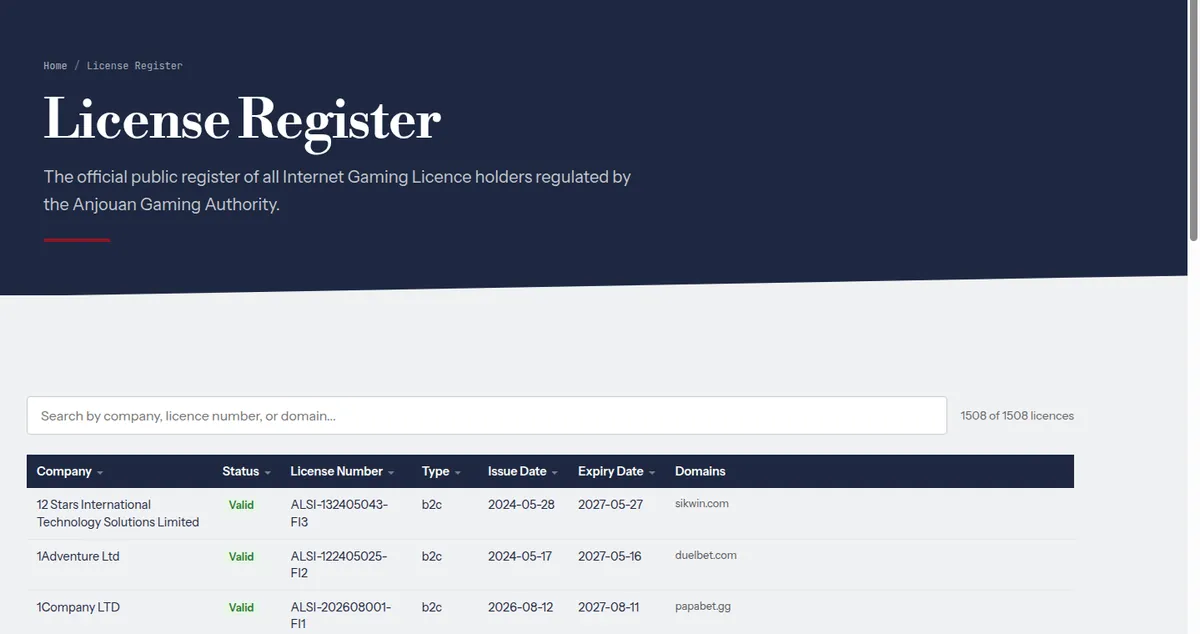
Nine of the ten sites publish a mark, and all nine can be found in the issuer’s register. Four Curaçao OGL numbers, four Anjouan ALSI numbers, and one entry in the older 1668/JAZ format.
That says a good deal about whether the authorisation exists, and almost nothing about what the contract contains. The Anjouan four are good evidence of it: the same issuer stands behind them, yet only one has a written identity threshold and the other three do not.
The reverse holds too. Of the four sites on a Curaçao OGL number we found a payout ceiling at two and not at the other two. Our page on where the authorisation sits unpacks that observation number by number.
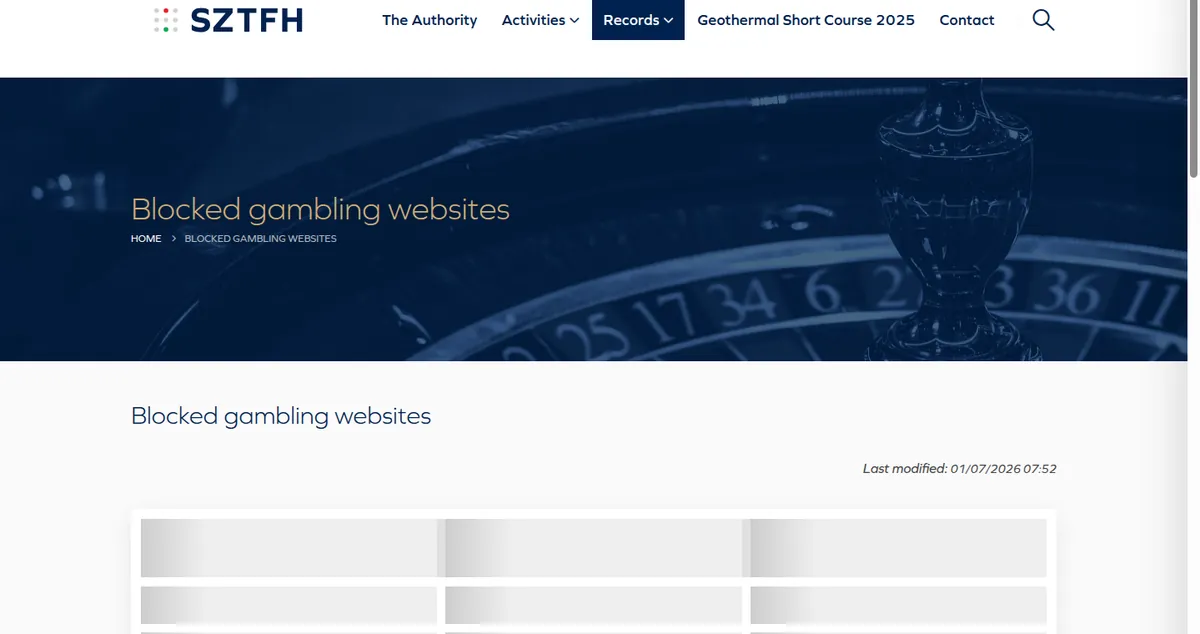
And a valid mark certainly does not mean a Hungarian authorisation. In the reading of 2 September 2026 the Hungarian permit list holds three website addresses, and none of the ten above is among them.
Why there are no stars or scores here
A star rating aggregates, and aggregating means the data have to be commensurable. Ours are not.
We read out four payout ceilings, and the four figures cover two different periods in three currencies. Between $5,000 a month and a million USDT a week no conversion produces an ordering that still means anything.
At the identity threshold the position is worse still. Three contracts carry a figure, six do not, and the absence is neither worse nor better than a figure — it is different. A stated threshold of $2,500 can be planned around, but it does not protect you from documents being requested above it; the absence of a statement permits the same thing at any amount.
If we kneaded those two into one number, we would be inventing the weights. And the reader would not be seeing what the contract says, but what we think about it.
How an experience becomes a usable review
Anyone who wants to write a review somewhere themselves can make it useful with four items, and all four are already in their own correspondence.
The date, because contracts change. The clause number, or the sentence the operator cited, because that is what makes the whole thing traceable. The amount and the currency, because ceilings and thresholds stand currency by currency. And how much time passed between the request and the answer, because a deadline written in days and the actual turnaround are two different things.
Those four items are worth more than ten sentences about whether it was good or bad.
What to do if a payout stalls
The first step is the right clause of the contract, because the answer is nearly always there, just not where people look. The clause on verification, the clause on the payout ceiling and the clause listing grounds for refusal — those three settle most cases of this kind.
Hungarian official redress cannot be expected at these sites. None of these operators is under Hungarian supervision, so a dispute has to be run through their own complaints procedure and the rules of the jurisdiction that licensed them. That is the largest difference from the three websites on the Hungarian permit list, and no clause of a contract can substitute for it.
Anyone for whom the play itself is the trouble needs a telephone number rather than a set of pages: 80 980 025 can be called free of charge on weekdays between 15:00 and 19:00. How that differs from the authority’s freephone line is set out on its own page.