
Two clauses decide how much money can leave the account
The verification and withdrawal clauses of the terms
We read 9 of the ten sets of terms. On identity checks, three print a specific threshold and six only an authorisation to decide case by case; four contracts write a payout ceiling as a number. These two clauses decide when the money stops, and not one of them is written in forints.
Identity checking is not a question of authorisation. Of our 4 sites operating on a Curaçao number, one writes a specific threshold into its terms and the other three do not, even though the same body issued their entries.
There are two gates on the path the money takes. The first is verification: does the operator ask for documents, and above what amount. The second is the payout ceiling: how much can go out in a given period.
The two sit in separate clauses of the contract, and they work separately too.
The terms are in English, and that is the one advantage here
Everything else on this site comes out of Hungarian sources. The operator terms do not: all nine sets we read are published in English, and several of them have no Hungarian version at all.
For a reader in Hungary who works in English, that reverses the usual difficulty. The register that says whether a site is permitted is Hungarian-only; the contract that decides whether your money comes back is not. Of the two documents, the second is the one you can read in full, so it is the one worth spending the quarter of an hour on.
Ten casinos with no Hungarian concession. Licence numbers come from the issuing register, everything else from the operator’s own terms as read on 26 August 2026. An empty cell means we could not read the figure out — never that it is zero, and never that there is no limit.
- Rocketpot
-
- LicenceCuracao
- CompanyDanneskjold Ventures B.V.
- Before ID is askedUS$2,500
- Bitcasino.io
-
- LicenceCuraçao Gaming Authority
- CompanyMoon Technologies B.V.
- Before ID is asked2,500 EUR
- Wild Fortune
-
- LicenceAnjouan Gaming Board
- CompanyMetlait SRL
- Before ID is askedcase by case
- DuckDice
-
- LicenceAnjouan Gaming Board
- CompanyZentari Limitada
- Before ID is askedcase by case
- Empire.io
-
- LicenceAnjouan Gaming Board
- CompanyPixel Entertainment Limited
- Before ID is asked2,000 USDT
- Metaspins
-
- LicenceCuraçao Gaming Authority
- CompanyMetaspins N.V.
- Before ID is askedcase by case
- Rainbet
-
- LicenceAnjouan Gaming Board
- CompanyRBGAMING N.V.
- Before ID is askedcase by case
- Shuffle
-
- LicenceCuraçao Gaming Authority
- CompanyNatural Nine B.V.
- Before ID is askedcase by case
- Wild.io
-
- LicenceCuraçao Gaming Authority
- CompanyNonce Gaming B.V.
- Before ID is askedcase by case


The first gate: three operators write down an amount
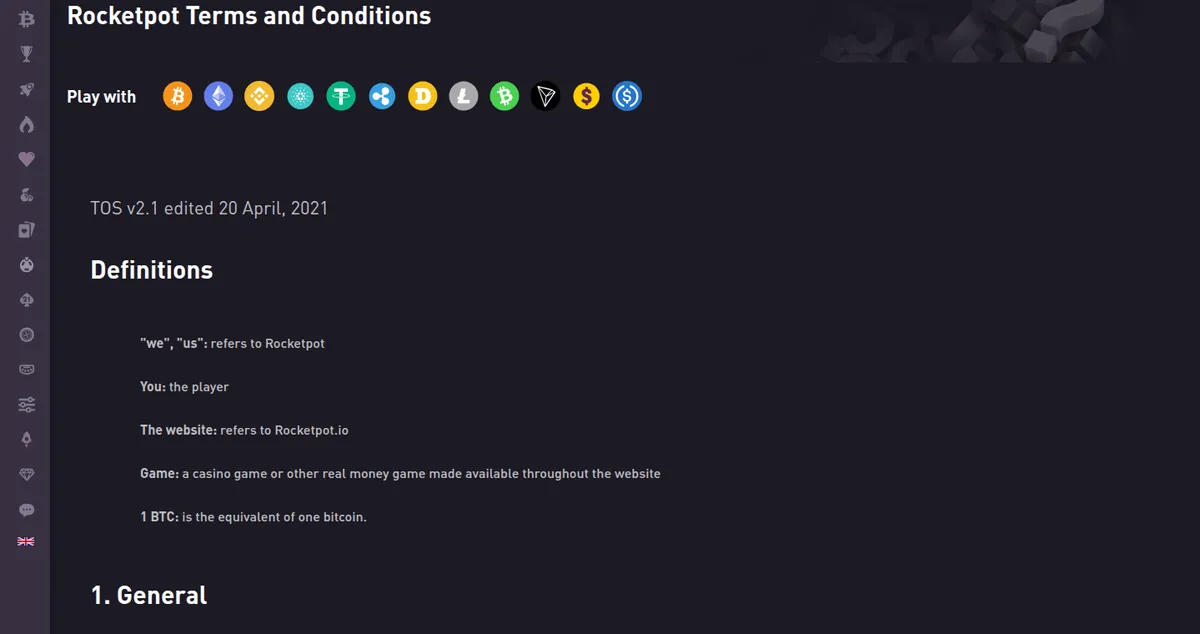
Rocketpot. Under clause 11.4 of the terms, verification may follow on a withdrawal exceeding $2,500. The same clause also sets a deadline: identity and source-of-funds documents requested must be submitted within 30 calendar days. We found no written deadline like that in any other contract.
Bitcasino.io. Clause 6.6 ties further checks to a withdrawal exceeding €2,500, or the equivalent value in cryptocurrency.
Empire.io. Clause 5.4 requires a further verification procedure above 2,000 USDT.
All three texts add the same rider: documents may be requested at smaller amounts too, where the conditions of the authorisation require it. So the figure is not a threshold below which nothing can happen; it is the point above which the contract says to expect it.
The six operators that leave it to their own judgement
Clause 18.1 at Wild Fortune, section 2 of the DuckDice terms, clause 9.7 at Metaspins, clauses 5.2 and 8.3 at Rainbet, and clause 4.1 at Shuffle all say the same thing in different words: the operator may request documents at any time, at its own discretion. Wild.io sets the same rule out in its responsible gaming policy, but there we could not read a clause number.
This is not a milder rule than a figure. It is a stricter one.
Where there is no threshold, the threshold can be anywhere, including at the first withdrawal. In two places that is visible in concrete terms: under the Wild Fortune terms, players using bitcoin must submit a valid document before play begins, with deposits and betting locked until they do, and the Rainbet policy ties verification to opening the account in the first place.
We could not read the tenth site’s terms out, so that field is empty in the table. It does not mean there are no identity checks there.
Why the wording in the contract matters
Because the difference shows up once the money is already inside.
A published threshold is something you can plan around: you know at what size of withdrawal to expect a document request, and you can decide in advance whether you want to be in that position.
Case-by-case judgement cannot be planned around. The same withdrawal goes through one day and triggers a document request the next, and the wording of the terms does not let you predict it. What the contract gives in that case is not a rule but an authorisation.
The document request is most likely to fire where there is no deposit of the player’s own on the account. That is why it is worth reading this same clause in advance before taking a no-deposit offer.
The second gate: the payout ceiling
The ceiling is the sentence that says how much money can leave the account in a given period. We read it out of four contracts, and all four sit under a different clause number:
| Operator | Ceiling | Period | Clause |
|---|---|---|---|
| Rocketpot | 5 000 USD | month | 11.5 |
| Wild Fortune | 15 000 EUR | month | 11.8 |
| Wild.io | 100 000 USD | week | 9.6 |
| Bitcasino.io | 1 000 000 USDT | week | 6.10 |
The four figures are not comparable, and that is the point
Two are monthly, two weekly. They involve two different currencies and one stablecoin.
We convert nothing: exchange rates move, while the contractual condition is written in the currency the operator will apply it in, so an approximation in forints does not help. It manufactures the appearance of a precision that is not there.
What can be compared is the order of magnitude. On a monthly basis there is a threefold gap between Rocketpot’s $5,000 and Wild Fortune’s €15,000. On a weekly basis there is a tenfold gap between Wild.io’s $100,000 and Bitcasino.io’s 1,000,000 USDT.
So a single table sets side by side sites where one lets out in a month what the other lets out in two days.
The Metaspins case: a clause with no figure
The Metaspins terms contain a clause on withdrawal limits, 12.5, but it holds no amount. That is how we record it: we read the clause number out, and not the figure, because there is none in it.
This is the sharpest example of why asking “is there a limit” is not enough. There is a place in the contract set aside for it; it is simply not filled in, so the operator supplies the content when the moment comes.
In four contracts we found no such clause
We read the terms of DuckDice, Empire.io, Rainbet and Shuffle, and found no figure in them relating to a payout ceiling. At the tenth site we could not read the text out, so that field stays empty.
That sentence is worded deliberately. We do not write “there is no limit”, and we do not write “unlimited”. We write that we found no figure.
The whole difference sits between the two, because an unread ceiling turns into “unlimited withdrawals” the moment someone sells the gap as an advantage. That is also what our rule for reading documents is about.
Which clause to look under, operator by operator
The two questions sit in two separate places, and we print the clause numbers so that you do not have to comb the whole text:
| Operator | Verification clause | Payout ceiling clause |
|---|---|---|
| Rocketpot | 11.4 | 11.5 |
| Bitcasino.io | 6.6 | 6.10 |
| Wild Fortune | 18.1 | 11.8 |
| Wild.io | responsible gaming policy | 9.6 |
| Metaspins | 9.7 | 12.5, no amount |
| Empire.io | 5.4 | none found |
| DuckDice | section 2 | none found |
| Rainbet | 5.2 and 8.3 | none found |
| Shuffle | 4.1 | none found |
Two things are visible at once. First, the two clauses are rarely next to one another: at Wild Fortune there are seven sections between them, so anyone who finds only one easily concludes that the other does not exist.
Second, the numbering differs completely from operator to operator. There is no such thing as “the withdrawal clause is always the eleventh”, which is why a general guide is not enough: each contract has to be searched separately.
The tenth row is absent here, because at that operator we could not read the terms out.
There is a third lesson, and it is the least comfortable. In four contracts the right-hand column says we found no clause: we read the text and it contained no figure pointing to a payout ceiling. That is not the same as the Metaspins case, where the clause exists but carries no amount, and neither is the same as never having opened the contract at all.
Three different kinds of absence, three different marks. In most tables all three look identical — an empty cell or a dash — and from that point on the reader cannot tell them apart.
What is asked for, when it is asked for, and how long you get
One of the contracts also lets you read out what is meant by verification.
Rocketpot’s clause 11.4 names identity documents and source-of-funds documents, and the same clause gives the deadline: thirty calendar days to submit what was requested.
That is the only written deadline in the nine sets of terms we read. The other contracts either say nothing about time, or say it so generally that no figure can be read out.
Proof of source of funds deserves separate attention, because it is not the same thing as proof of identity. The latter needs a document; the former needs something showing where the deposited money came from. The two are often requested in one sentence, and the second is typically a good deal more work.
What we cannot read out of these nine contracts is what happens after the deadline passes. We found no sentence of that kind in any of them, so we claim nothing about it here.
What the figure is written in: not forints, and not coins
Look at the currency the ceiling is written in. At Rocketpot it is dollars, at Wild Fortune euros, at Wild.io dollars, at Bitcasino.io USDT. The identity thresholds are the same: dollars, euros, USDT.
Not one figure is in forints.
That has a consequence for a player thinking in forints: every limit is approached through a conversion, the rate moves, and the contractual number does not. If the condition speaks of €2,500, it will still speak of €2,500 when the forint stands somewhere else.
The same is true of cryptocurrency. The ceiling is not written in coins but in a currency, and if the number stands in USDT then it will be applied in USDT, even where the deposit arrived by some other instrument.
The coin list is the most visible and least decisive figure
For seven operators we could read out the number of cryptocurrencies handled:
| Operator | Coins handled |
|---|---|
| Rocketpot | 13 |
| Wild.io | 12 |
| Wild Fortune | 10 |
| DuckDice | 10 |
| Rainbet | 9 |
| Metaspins | 8 |
| Shuffle | 6 |
At three sites this field is empty, because we did not read it out. It does not mean they handle zero coins.
The head of every list looks similar. Bitcoin, ether and litecoin are in nearly all of them; alongside those, bitcoin cash, dogecoin, solana, tron and cardano appear in varying combinations, and the Shuffle list also carries a coin of its own, SHFL.
So the difference between six and thirteen is not settled at the top of the list but at the bottom, where the rarer instruments sit. For anyone arriving with bitcoin or ether, the coin count says essentially nothing.
Why reading it once is not enough
The figures above belong to one day, 26 August 2026, and sets of terms move faster than that.
An operator can rewrite its own contract at any time. A new clause goes in, the old ones are renumbered, a threshold moves up or down, and the player typically gets no separate notice of any of it.
That is why we print the clause number beside every single figure. The number is what makes rereading fast: instead of combing the whole document, you find one clause and see whether it still says the same thing.
Three situations can arise, and all three mean something. If the clause is there and the figure is the same, the condition has not changed. If the clause is there but carries a different figure, it has changed, and the difference is worth noting. If the clause is gone, the contract has been renumbered and the search has to be based on the text.
The worst case is a figure with neither a clause number nor a date beside it. Then it is impossible to say whether the contract changed or the claim was wrong, and the reader has nothing to hold on to.
So before a deposit, the thing to do is not to believe our table but to use the clause number to check it yourself in half a minute.
What to do before you deposit
Open the terms and search for “verification” or “KYC”. A Hungarian translation is rarely published, so search in English.
See whether there is a figure in the text. If there is, note the clause number as well, because that is what can be cited in a dispute. If there is not, the answer is not that no documents will be requested but that they may be requested at any time.
Search separately for “withdrawal”. The ceiling nearly always sits where the withdrawal procedure is described, and the two clauses are often ten pages apart in the same document.
Check what period the figure applies to. Daily, weekly and monthly limits all occur, and the same amount means something quite different in each.
Finally, read the country list too, because that is yet another part of the document. Where that paragraph sits is shown on the page about foreign authorisation.