
Three Hungarian permits, and ten sites licensed elsewhere
From the wording of the act
Three online casinos hold a Hungarian permit, and all three belong to the same permit holder. The ten sites collected below sit outside that list, which is what "casino without a licence" means here: no Hungarian concession. It does not mean the operator holds no authorisation anywhere in the world.
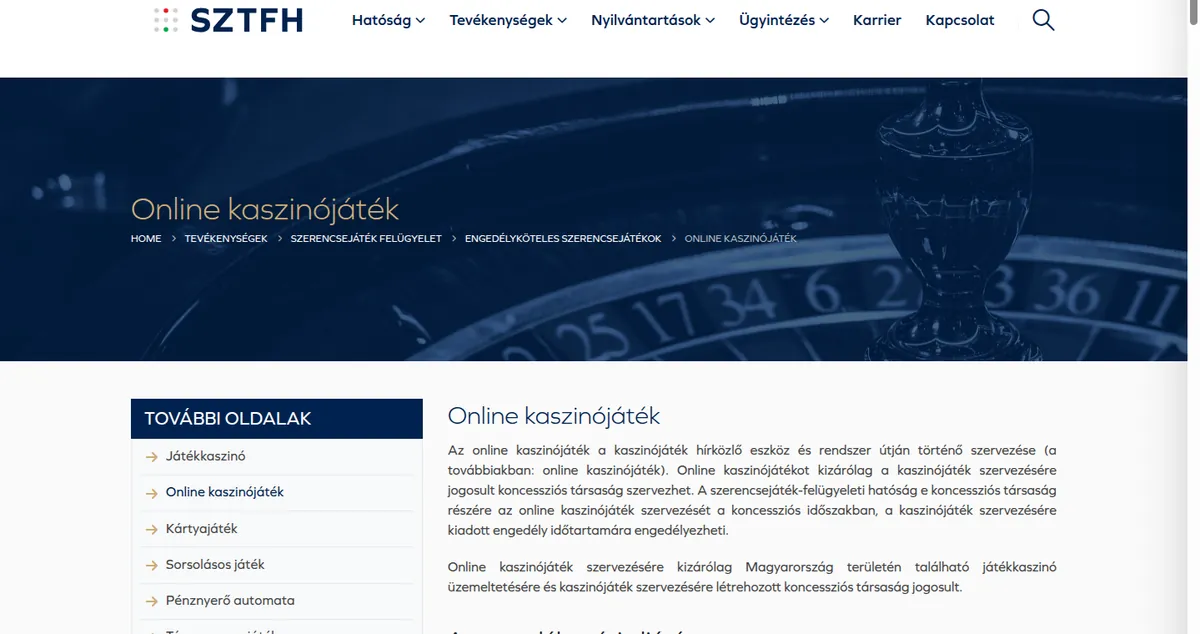
The authority’s register of authentic permits lists kaszino.hu, vegas.hu and xcasino.hu. That is the complete Hungarian roll; when we opened it on 1 September 2026, no row carried a suspension mark.
None of the ten sites below appears there. Nine of them quote a licence number, from Curaçao or from Anjouan, and each of those numbers can be looked up in the register of the body that issued it.
Those are two separate questions, and Hungarian search results habitually melt them into a single star rating. Here they stay apart, each with its source.
Reading this from Hungary without reading Hungarian
Everything on this page comes out of documents that exist only in Hungarian. The act, the decrees, the two registers, the helpline pages: none of them has an official English version, and the register search boxes expect Hungarian column names.
That is the practical problem this page is built around. A resident who cannot read the source has to take somebody’s summary on trust, and the summaries in circulation are where the errors are. So every claim here carries the section number, the register tab or the clause it came from, spelled the way it is spelled in the original. The Hungarian string is what you paste into the search box; the English around it is only there so you know what you are pasting.
Institution and statute names therefore stay in Hungarian, with a gloss the first time they appear. Amounts in forints, permit numbers and dates are copied across unchanged, because they are the part you can check.
Ten casinos with no Hungarian concession. Licence numbers come from the issuing register, everything else from the operator’s own terms as read on 26 August 2026. An empty cell means we could not read the figure out — never that it is zero, and never that there is no limit.
- Rocketpot
-
- LicenceCuracao
- CompanyDanneskjold Ventures B.V.
- Before ID is askedUS$2,500
- Bitcasino.io
-
- LicenceCuraçao Gaming Authority
- CompanyMoon Technologies B.V.
- Before ID is asked2,500 EUR
- Wild Fortune
-
- LicenceAnjouan Gaming Board
- CompanyMetlait SRL
- Before ID is askedcase by case
- DuckDice
-
- LicenceAnjouan Gaming Board
- CompanyZentari Limitada
- Before ID is askedcase by case
- Empire.io
-
- LicenceAnjouan Gaming Board
- CompanyPixel Entertainment Limited
- Before ID is asked2,000 USDT
- Metaspins
-
- LicenceCuraçao Gaming Authority
- CompanyMetaspins N.V.
- Before ID is askedcase by case
- Rainbet
-
- LicenceAnjouan Gaming Board
- CompanyRBGAMING N.V.
- Before ID is askedcase by case
- Shuffle
-
- LicenceCuraçao Gaming Authority
- CompanyNatural Nine B.V.
- Before ID is askedcase by case
- Wild.io
-
- LicenceCuraçao Gaming Authority
- CompanyNonce Gaming B.V.
- Before ID is askedcase by case


What “casino without a licence” actually covers
It means the operator holds no Hungarian concession. Those words say nothing beyond that, and most of the confusion around them comes from three different meanings being poured into one phrase.
It does not mean no authorisation of any kind. Nine of the ten quote a mark you can look up, so the authorisation exists — it was simply not granted by Hungary.
It does not mean no identity checks either. That is a separate matter, written differently by each operator, and each of them settles it in its own terms.
And it does not mean that a Hungarian player commits an offence by opening such a site. The szerencsejáték törvény says nothing of the kind, and the petty offence provision is addressed to public spaces and public places.
What the act itself calls an online casino game
Behind the everyday phrase “online casino” sits a precise term in the legislation, and the act supplies the abbreviation itself. Section 1 (6) defines it in brackets:
„hírközlő eszköz és rendszer útján szervezett kaszinójátékban (a továbbiakban: online kaszinójáték)”
That is a casino game organised by means of a telecommunications device and system, thereafter called an online casino game. The same subsection, in the same list, separately names games organised in a land casino and in a card room, and remote gambling. Four distinct concepts in one sentence, and the legislation keeps them apart throughout.
This is why the choice of word in a summary matters. The umbrella term “online gambling” swallows betting and casino play alike, while their rules differ — and the news coverage of market opening went wrong at exactly this point.
The three permitted sites and who stands behind them
All three are held by the same company: LVC Diamond Játékkaszinó Üzemeltető Kft., registered seat 1088 Budapest, Rákóczi út 1–3.
The register publishes five items per website: the address, the permit holder’s name and seat, the validity of the permit, whether the authorisation is under suspension, and, in a fifth column, the operating permit itself, offered for download. All three rows show 31 March 2056 as the validity date, and none is marked as suspended.
That date is close to thirty years from the day you are reading this. So the list is not short because few applicants happen to be in the queue right now; it is short because the authorisations run for a very long time and the act is narrow about who may ask for one.
Anyone who sees a longer Hungarian roll somewhere is reading sites with foreign authorisations listed as Hungarian permit holders. The full permit list, row by row, fits on one page, difference between the tabs included.
Three or four: what the people who write four are counting
Two numbers circulate side by side in Hungarian search results, and the gap is not an error but a different denominator. So we read the source again on 2 September 2026; its timestamp then read 2026.09.01. 06:18.
The online casino tab held three data rows under the header. The remote gambling tab held two. Four different numbers can be pulled out of that, and each is true to its own question:
One. That is how many companies hold a permit to organise online casino games: LVC Diamond. There are not three companies behind the three web addresses.
Three. That is how many web addresses stand on the online casino tab. This is the number to give when the question is how many legal Hungarian online casinos there are.
Four. That is how many distinct domains appear across the two tabs together, because vegas.hu is on both and tippmixpro.hu is on the betting tab only. Treat the two tabs as one list and you get four — except that the fourth address covers a betting authorisation, not casino play.
Five. That is the total number of data rows across the two tabs.
So four is not a lie, it is a blend: it adds up rows belonging to two separate legal instruments. Anyone looking for an online casino wants the three, and looks at the betting tab separately.
The fourth address we did not find on the list today
There is another route to four, and this one is not a question of denominators. The fourth website address that keeps recurring in Hungarian round-ups is grandcasino.hu.
In the 2 September 2026 reading, that address does not occur once in the whole text of the register. Not on the online casino tab, and not on the other four tabs either.
What we claim from that is this much: on that day it was not on the list. What we do not claim is why. We have read no decision on the matter, so we write nothing about expiry, withdrawal or suspension, and we do not borrow anybody else’s explanation.
One name collision is plainly visible, though, and it explains why the name still looks like a permit holder. The land casino tab carries a venue called GRAND CASINO at 4026 Debrecen, Péterfia u. 18., permit holder LVC Diamond, valid to 2061.02.12., permit number 253. That is a physical casino, not a website, and a search for the domain will surface it anyway.
If you read somewhere that Hungary has four legal online casinos, there is one thing worth checking: whether the fourth name appears in the register as a web address or as a venue.
The responsible-organiser mark beside the rows
All five data rows carry something else that Hungarian summaries almost never quote. After the permit holder’s name and seat comes a mark: ajánlott felelős játékszervező, recommended responsible game organiser.
This is not the operator describing itself. It is an official rating whose conditions are set in legislation. Chapter V of SZTFH decree 5/2021. (X. 21.) governs it, and section 22 imposes two conditions. The first is framed in terms of fines: in the year before the application was filed, the Authority must not have imposed a fine exceeding one million forints on the organiser in a final decision. The second is a choice: either continuous provision of one extra player-protection measure, or at least five million forints given to the organisations the decree names.
The decree closes the question of duration in a single sentence:
„Az ajánlott felelős játékszervezői minősítést a Hatóság 1 éves időtartamra állapítja meg.”
The Authority grants that rating for a period of one year. Section 22 (4) permits the organiser to display the rating on its website, in the gaming area and in its advertising, next to its company name or logo. Section 23 says when it lapses: if, during the period of validity, a final decision imposes a fine of more than one million forints on the organiser.
One thing matters to the reader here. In the whole register this is the only entry that does not tell you whether a website is permitted; it tells you how its operator behaved over the past year. And because it runs for a year, its absence is not permanent either.
Why that rating is hard to earn if you only operate online
Section 24 of the decree lists the measures an organiser may pick from if it wants the rating through the broader branch of the second condition. That list is written for venues, and one of its points says so outright.
Point c) requires five hours a week of information activity on the premises used to organise the game — and the subsection opens with the words “except for remote gambling and online casino games”. Point a) concerns slot machines per casino unit, point b) clocks installed in a land casino or a card room. None of them can be applied to an organiser with no premises.
That leaves point d), which applies to all games of chance: free and direct access to a qualified person during at least fifteen per cent of opening hours, or player-protection rules drawn up with a professional organisation, or a dependency test kept permanently available. And it leaves the funding branch with its five million forints.
From which follows an observation that the register itself supports. The mark is worn by the company that also has venues: on the land casino tab, six of the nine rows belong to LVC Diamond. So a Hungarian online casino is not Hungarian because its servers sit here; it is Hungarian because a Budapest casino concession hangs off the other end.
The fifth column nobody quotes
After the web address, the permit holder, the validity and the suspension field, there is a fifth column: the operating permit, offered for download row by row.
That is more than a tick in a table. The authority does not merely assert that the permit exists; it hands over the instrument itself to anyone who clicks. Not one of the ten sites below has an equivalent: there, the authorisation is looked up in the issuing body’s own register, and in most cases the instrument itself cannot be downloaded from anywhere.
We did not download the file, so we write nothing about its contents. We record that it is there, because the existence of the column is itself an answer to the question of what a state register can do that an issuer’s own register cannot.
Market opening touched betting, not the online casino
This is the most important sentence on the page, and it is almost nowhere to be found in Hungarian search results.
The szerencsejáték törvény uses two separate legal instruments, and they are constantly mixed up. Online casino play is tied to a concession, and section 3 (1b) says whose that concession can be:
„Online kaszinójátékot kizárólag a Magyarország területén található játékkaszinó üzemeltetésére szóló koncesszió jogosultja által a kaszinójáték szervezésére létrehozott vagy működtetett koncessziós társaság szervezhet.”
Only a concession company created or operated for the organisation of casino games by the holder of a concession to operate a casino located in Hungary may organise an online casino game. Remote gambling — betting organised at a distance — is by contrast tied to a permit. Section 29/D. § (1) reads:
„A távszerencsejáték szervezését a Hatóság elnöke által kiadott rendeletben meghatározott feltételeknek megfelelő gazdasági társaság végezheti.”
Remote gambling may be organised by any business company meeting the conditions laid down in a decree issued by the president of the Authority. On one side, the holder of a domestic casino concession; on the other, any company that meets the conditions. Anyone reading that “Hungary has opened its online casino market” is seeing two separate institutions as one.
Section 29/D. § (2) adds one more condition on the betting side: the fee must be paid in advance, in a single sum, without instalments, for the entire period. That sentence is a financial filter, and it is a different logic again from the casino-side concession, where the entry ticket is not how the fee is paid but the operation of a casino in Hungary.
The state lottery company does not hold the online casino
You will often read that online play in Hungary is a monopoly of Szerencsejáték Zrt. The two tabs of the register give a more precise picture.
The permit holder of the three websites on the online casino tab is LVC Diamond, a casino operating company. Szerencsejáték Zrt. turns up on the other tab, as the remote gambling holder for tippmixpro.hu, with its seat at 1015 Budapest, Csalogány u. 30–32.
Two different companies, two different legal instruments, two different tabs.
This is not hair-splitting. Someone who reads “state monopoly” and therefore never opens the list is missing precisely the three rows that answer their question.
Who decides what is legal, and where to look it up
The Szabályozott Tevékenységek Felügyeleti Hatósága, the Supervisory Authority for Regulated Activities, whose gambling arm goes by the name Szerencsejáték-felügyelet. The legislation does not use that name, though: there it is simply “a Hatóság”, the Authority, and anyone searching the act for the initials SZTFH will not find them.
The same body keeps both the permit list and the registers of restrictions. The two are not opposites of one another: a domain can be missing from both, and that is the more common case.
The text of the legislation lives elsewhere, in the Nemzeti Jogszabálytár, the national legislation database. The choice of address matters there, because the shorter form returns a blank page without a browser plug-in, and at that point people conclude the act is unavailable.
What the act says about the player, and what others say about it
The penalties in the szerencsejáték törvény are addressed to the organiser, the intermediary and the advertiser. Website blocking, payment blocking, advertising fines. Nothing for the player.
The single provision that does address the player is not in the gambling act at all but in section 191 of the petty offences act, and it contains a limiting clause:
„Aki közterületen vagy nyilvános helyen tartott tiltott szerencsejátékban részt vesz, szabálysértést követ el.”
Whoever takes part in a prohibited game of chance held in a public space or a public place commits a petty offence. Public space or public place. That is street card games and games held in public premises. Its wording does not reach a person playing in their own home on their own device.
The first subsection of the same section opens with those same four words and deals only with organising. So the frame of the provision is the same in both directions, and anyone quoting the second subsection without the frame is dropping half of the section. The rules that apply to the player fit on a single page in full.
The register anyone can open
The SZTFH publishes blocked websites in a table, with no file to download. It has five columns: serial number, blocked domain, the name of the organisation running the prohibited game, bank account and remarks. In the state as of 31 August 2026, the highest serial number was 6,403.
It matters that this number is not an item count: it is the identifier of the record at the top of the list, not the number of domains on it. Where you read a “page count” in the five or six thousands, somebody has confused the two.
The authority keeps two further registers besides this one: blocked advertising sites and prohibited payment accounts. We did not open those two, so we claim nothing about them beyond the fact that they exist. What is visible in the third one, and how the other two connect to it, sits on one page.
Why you see no Hungarian-language advertising for these sites
Section 2 of the szerencsejáték törvény answers that, and what makes the sentence interesting is whom it lists:
„a reklámozót, a reklámszolgáltatót, a reklám közzétevőjét és a reklámban szereplő személyt egyetemlegesen … legalább 10 millió forint összegű közigazgatási bírsággal sújthatja”
Four parties, jointly and severally liable: the advertiser, the agency, the publisher, and the person appearing in the advertisement. The floor for the administrative fine is 10 million forints.
This section explains something anyone can observe. Offers from sites with no concession essentially never appear in large-format, television or outdoor campaigns, because every link in the chain is exposed.
Notice too who is not in the list. The person playing does not appear in it, just as they appear in no other penalty sentence in the act.
The authority keeps a separate register of blocked advertising sites for this purpose. We did not open that list, so we claim nothing about its contents.
Not one operator shuts Hungary out
Operators state in their own terms which countries they will not accept players from. That is their document, not a Hungarian official decision.
We read that list for nine of the ten operators. Hungary is on none of them. For the tenth we could not read the paragraph out, so we claim nothing about it.
The phrase “foreign online casino” marks the same circle in Hungarian: an operator whose registration lies in another jurisdiction. That page also holds the nine sites that do explicitly exclude Hungarian players, and which for that reason did not enter the table above.

The four numbers the contracts yield
Four kinds of figure came out of the ten sets of documents, and all four can be traced back to a clause number.
Licence number and status. Four operators quote a Curaçao OGL mark, four an Anjouan ALSI mark, and one the older Curaçao 1668/JAZ format. The Curaçao entries showed a status of “Active” and the Anjouan ones were valid; one status field could not be read out.
Identity threshold. Three contracts print a specific figure: $2,500, €2,500 and 2,000 USDT. Six operators print no number at all and instead reserve the right to ask for documents at any time.
Payout ceiling. We read one out of four contracts: $5,000 a month, €15,000 a month, $100,000 a week and 1,000,000 USDT a week. Two monthly limits and two weekly ones, in three currencies, so the four numbers are not even commensurable.
Number of coins handled. We could read this for seven operators, and it scatters between 6 and 13. The head of every list looks similar; the difference is at the tail.
Not one figure is in forints. That has a practical consequence for a reader who thinks in forints, and the two contractual gates page spells it out clause by clause.
Ten operators, ten separate pages
Behind every row of the list above is a page carrying the same items with their sources: which clause of the contract covers identity checks, what the same text says about withdrawals, and which register holds the mark.
These are not ratings. There is no score, no star and no recommendation on any of them, because we have no measure that would produce such a thing. What they do is different: they put in one place the two or three paragraphs the operator scattered across its own terms.
The advertising partner’s page was made the same way as the rest, with the difference that it is where the most numbers come out of the contract — and where the sentence covering the largest win sits.
If you would rather skim all ten in one go, the index of operator pages is for that, and it also covers what to do with somebody else’s review.
Two gates, two different numbers
The ten contracts can stop a payout at two points, and the two are not the same thing.
The first is identity verification. Three operators print a specific amount: clause 11.4 at Rocketpot gives $2,500, clause 6.6 at Bitcasino.io gives €2,500, and clause 5.4 at Empire.io gives 2,000 USDT. Six operators print no number and leave it to their own judgement when documents are requested.
The second is the payout ceiling, and the picture there is different. We found a figure in four contracts, but the four are in four different units: five thousand dollars a month, fifteen thousand euros a month, a hundred thousand dollars a week and a million USDT a week. Two monthly and two weekly limits, in three currencies. They cannot be compared, and they certainly cannot be added.
The part that matters is what comes out of the two meeting. A contract with no written identity threshold but a written ceiling behaves quite differently from one built the other way round. The two gates, clause by clause, are set out with the numbers.
The bonus is not a separate rule, it is those same two numbers and one more
Most Hungarian searching around no-deposit offers is looking for the size of the amount. We publish no bonus amounts, because that clause was opened at no operator at all.
A wagering requirement, though, was read out of four sets of terms, all of them attached to deposit offers. Clause 9 of the Rocketpot bonus terms writes 100x, with the reservation that an individual offer may say otherwise; clauses 11, 12 and 13 of the same document count the house's own games at a tenth of the stake and table games, live tables, video poker and sport at nothing. Bitcasino.io writes 30x in the terms attached to its promotion page, on the bonus money alone, with seven days to complete it, a highest permitted stake of 4 USDT and a smallest deposit of 50 USDT. Rainbet writes 40x on the one of its two paths named after that figure, multiplying deposit and bonus together. Wild.io stands with us at 40x.
Three of those four figures carry no clause number, and that is written here rather than glossed over. Only Rocketpot's sits in a numbered clause; the other three sit in the operators' own promotional text, as read on 2 September 2026. At the remaining six rows the field is empty, and an empty field means we did not read it — never that no requirement exists.
What can be examined instead is the same pair of gates. Winnings from an amount received for nothing are held back by the same identity clause and the same ceiling as any other winnings, and the order is fixed: wagering first, then the cap that applies to the bonus, then the account ceiling, then the document. The no-deposit bonus page unpacks that order.
One row from the blocking register
We opened the authority’s restriction list again on 2 September 2026. The page timestamp was 2026.08.31. 15:18, so it had not refreshed since our previous reading, and the identifier at the top of the list is still 6,403.
The top row looks like this: identifier 6.403, blocked domain royalsea-hu101.com and its subdomains, organisation name Firo Lod N.V., the bank account and remarks fields empty. That row also shows what the third column is for: the same name can surface in several rows, and this is how the organisation behind a set of domains can be joined up.
The domains of the ten sites above are not at the head of the list. Whether they appear further down is something anyone can check by domain — the list lives on a web page and cannot be saved as a file, and what the five columns mean is set out on its own page.
The freephone line and the advice line are not the same number
Two Hungarian telephone numbers circulate around these subjects, and they do different things.
The authority’s player-protection freephone number is 80 205 352, which according to the authority’s own player-protection page can be called free of charge around the clock. It is a reporting channel: what reaches it is what falls within the authority’s remit.
80 980 025 is of a different nature. That is an advice line, callable on weekdays from three in the afternoon until seven, and there is a person at the other end. Someone struggling with their play wants that number, not the reporting one. Which of the two to call and when, and who funds the second, is unpacked on its own page.
How a contract clause becomes a cell
Every number in the list above can be read back under a clause number. That is not a formality: if a payout ceiling sits in clause 11.5, then checking our claim consists of opening clause 11.5.
Which is why we do not round, and why we never put “approximately” in front of a figure. A rounded threshold can no longer be found in the text, so it loses the one property it was written down for. Which claim belongs to which date, and what happens when we get something wrong, is on the methodology page.
Six questions instead of a ranking
Instead of a star rating there are six questions, and all six are answered from a document: is it on the Hungarian permit list, does it have a mark that can be looked up, what does the entry’s status say, is there a written identity threshold, is there a written ceiling, and does it accept Hungarian players.
The six together are about a quarter of an hour’s work for one site. What they do not settle is whether it is a good idea to play there. No document answers that question, and the run through the six says so on the page.
Free play and demo mode: we have no data
One common Hungarian search is about what can be played for free, and we have no answer to it.
For nine of the ten operators, both the game count and the provider names were left unread, and we did not read any operator’s terms on demo mode. A section on this could therefore only be invented, and this is the point where invention is easiest: anybody can write a number of games, and nobody ever checks it.
If that field fills in later, it will stand here, and its date will appear in the log at the foot of the page.
What you will not find here
No ranking and no star rating. No sentence claiming we tried anything: we hold no account with any of these operators and have paid in no money, so it would not be true. What can be settled from a document instead of a ranking has a page of its own.
No bonus amounts either, because that clause was not read out. A wagering requirement stands at four operators, with figures, and is set out above. What can nevertheless be examined around a no-deposit bonus also has a page.
No game counts and no provider lists, for the reason above: the field is empty for nine operators, and no operator’s demo rule has been read.
No technical advice. This site reads documents, and it does not discuss software or settings.
An empty cell means we could not read it out. Never that it is zero, and never that there is no limit — because an unread payout ceiling, read as “no ceiling”, turns a missing figure into an advantage for the operator. Where every number comes from, and what we do when we are wrong, is on the page about reading the documents.
Where to start if you are reading this before a deposit
Four steps, all free, about a quarter of an hour together.
Look the domain up in the SZTFH list. This is the one question the Hungarian state answers directly.
Find the licence number in the issuing body’s register. Curaçao certificates open at their own separate addresses; the Anjouan marks stand one after another in a single shared register.
Open the clause on identity verification in the terms. Three operators publish a specific threshold, six explicitly leave it to their own judgement.
Find the payout ceiling. Four operators write a number down, at four we found none even after reading the terms through, and at one we could not open the text at all.
Anyone whose play is becoming a problem can call 80 980 025 free of charge on weekdays between 15:00 and 19:00. How that number differs from the authority’s freephone line, and who funds it, is set out on the page about the two helplines.
Who these ten sites are not for
Anyone expecting Hungarian consumer-protection or official redress in a dispute. None of these operators is under Hungarian supervision, so a dispute has to be run through their own terms and the rules of the jurisdiction that licensed them.
Anyone looking for a first-hand account. There is none here.
Anyone who thinks in forints. Not one figure we read out is in forints: the identity thresholds are in dollars, euros and USDT, and so are the payout ceilings.
Anyone who wants predictable identity checks and will not accept case-by-case judgement. Six operators write exactly that into their terms.
And anyone already struggling with their play. What is needed then is not a list of sites but a telephone number.
Frequently asked questions
How many legal Hungarian online casinos are there?
Why do some Hungarian pages say four instead of three?
Is grandcasino.hu on the list?
What does the "ajánlott felelős játékszervező" mark in the register mean?
Can the Hungarian operating permit itself be downloaded?
Is a Hungarian player punished for playing on a site with no concession?
Can a foreign operator obtain a Hungarian permit?
How do I find out whether a site is blocked?
Why is there no Hungarian-language advertising for these sites?
Do any of these operators shut Hungarian players out?
What does it mean that a site holds a Curaçao licence?
Where can the games be tried for free?
What has changed since the last check
26 August 2026. We read out the licence entries and terms of ten operators. Nine succeeded, the tenth did not.
31 August 2026. This is the date on the timestamp of the SZTFH register of blocked websites; the serial number at the top of the list was 6,403.
1 September 2026. We read the authority’s pages on online casino games and on player protection. The second concession quotation comes from the former, and the description of how the freephone line works from the latter.
1 September 2026. We opened the authority’s permit register. Three rows stood on the online casino tab and two on the remote gambling tab; the page timestamp was 2026.09.01. 06:18.
2 September 2026. We reread both registers, because elsewhere we had read that there were four permitted platforms. The number of rows had not changed, nor had the page timestamp. This is when the fifth column, the rating beside the permit holders and the decree text behind it entered the page, and when we checked that the address named as the fourth elsewhere appears on neither tab of the list.
2 September 2026. We reopened the register of blocked websites too. Its timestamp is still 2026.08.31. 15:18 and the topmost identifier 6.403.