
Six checkable questions instead of a best-casino ranking
A checklist instead of a ranking
We give no star ranking, because we hold an account with none of these operators. In its place there are 6 questions answered by an official register or by the wording of a contract, all 6 checkable in half an hour, followed by four more questions you can put to anybody else’s review.
On comparison sites the word “best” usually hides an internal score whose formula is nowhere printed. We have no such formula either, and therefore no ranking: in the table above the advertising partner’s row comes first, marked as an advertisement, and below it the 9 other operators follow by how much data we could read out, not by quality.
What stands in place of a ranking is six questions. Each has a source, and the answers can be checked row by row in the table, as read on 26 August 2026.
None of the questions costs anything to answer.
Where the language barrier actually sits
Of the six questions below, the first is answered by a Hungarian-only register, and the other five by English-language documents.
That is worth knowing before you start, because the effort is not evenly spread. Question one takes half a minute even with no Hungarian, since you are matching a domain string against a list of three. Questions four and five are the long ones, and they are in English throughout.
Ten casinos with no Hungarian concession. Licence numbers come from the issuing register, everything else from the operator’s own terms as read on 26 August 2026. An empty cell means we could not read the figure out — never that it is zero, and never that there is no limit.
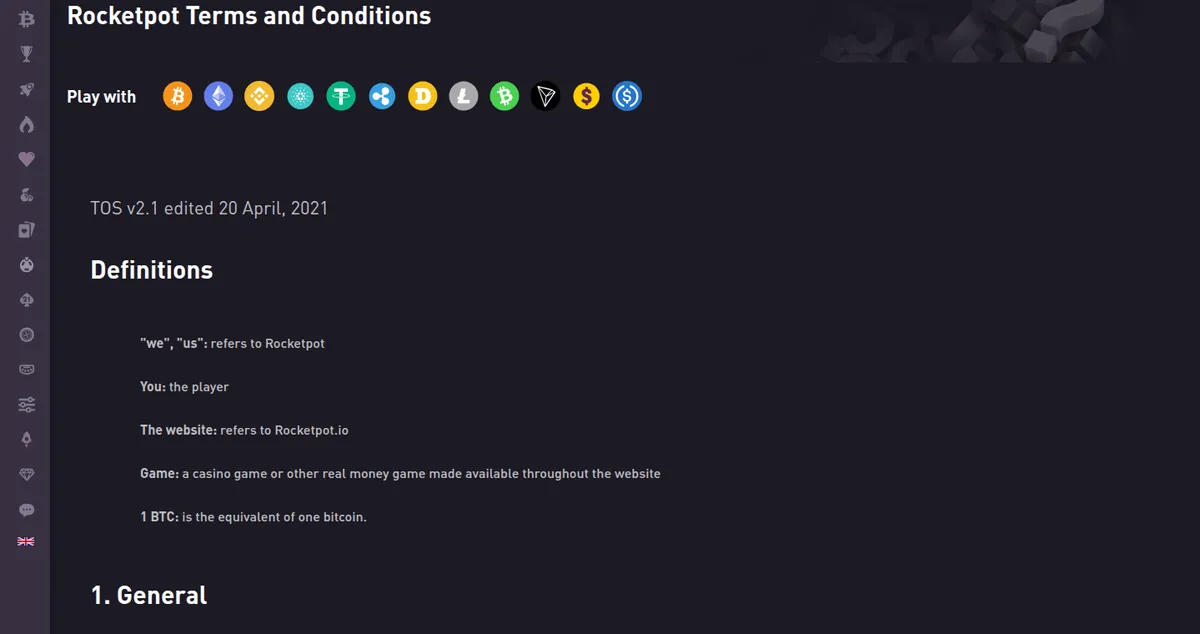
- Rocketpot
-
- LicenceCuracao
- CompanyDanneskjold Ventures B.V.
- Before ID is askedUS$2,500
- Bitcasino.io
-
- LicenceCuraçao Gaming Authority
- CompanyMoon Technologies B.V.
- Before ID is asked2,500 EUR
- Wild Fortune
-
- LicenceAnjouan Gaming Board
- CompanyMetlait SRL
- Before ID is askedcase by case
- DuckDice
-
- LicenceAnjouan Gaming Board
- CompanyZentari Limitada
- Before ID is askedcase by case
- Empire.io
-
- LicenceAnjouan Gaming Board
- CompanyPixel Entertainment Limited
- Before ID is asked2,000 USDT
- Metaspins
-
- LicenceCuraçao Gaming Authority
- CompanyMetaspins N.V.
- Before ID is askedcase by case
- Rainbet
-
- LicenceAnjouan Gaming Board
- CompanyRBGAMING N.V.
- Before ID is askedcase by case
- Shuffle
-
- LicenceCuraçao Gaming Authority
- CompanyNatural Nine B.V.
- Before ID is askedcase by case
- Wild.io
-
- LicenceCuraçao Gaming Authority
- CompanyNonce Gaming B.V.
- Before ID is askedcase by case


First question: is it on the Hungarian permit list
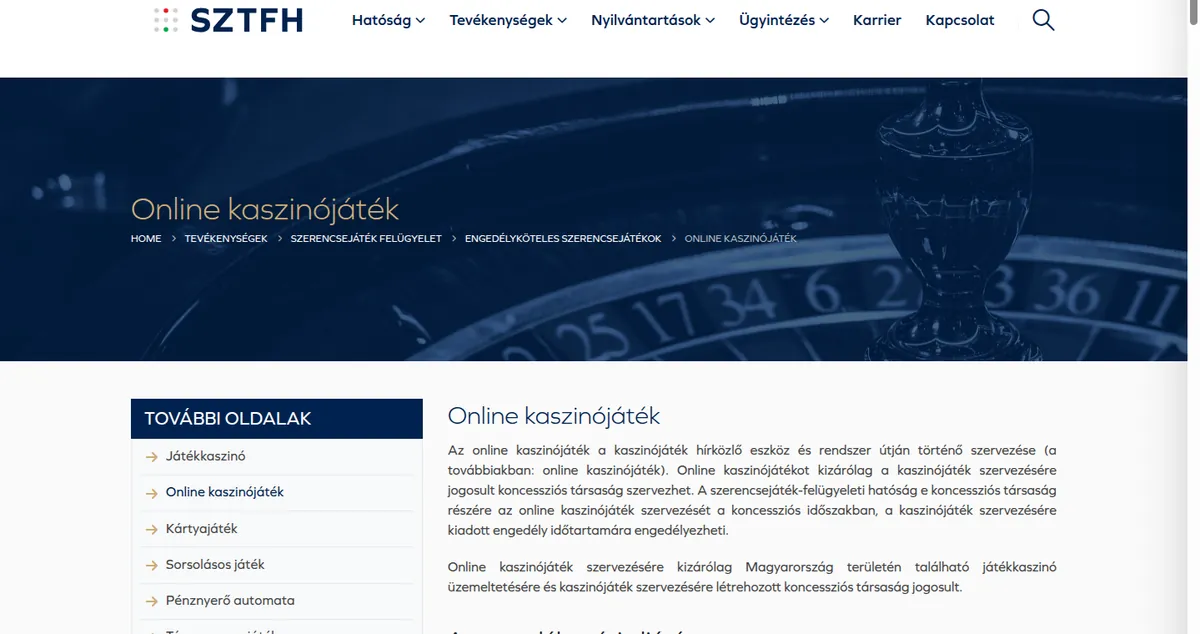
This is the fastest filter, and the one the fewest Hungarian sites print. The authority’s register of authentic permits holds three websites, under a single organiser.
None of the ten sites above is among them. That is a statement of fact, not a judgement: it means they hold no Hungarian authorisation, and that in a dispute no Hungarian forum will act.
This filter takes half a minute.
Second question: is there a number that can be looked up
Of the ten operators, 9 publish a licence number. Four use a Curaçao OGL mark, four an Anjouan ALSI mark, and one the older Curaçao format.
A logo is not a number.
A mark is worth something if it can be found in the issuer’s register. We checked that at all nine, and listed the three formats number by number.
Third question: what the entry’s status shows
In the Curaçao register four entries stood as “Active”; in the Anjouan one, four entries were valid. At one operator we could not read the status field, so that field stands empty.
An empty field here says nothing about the quality of the entry either. It says we did not look.
We do not fill a missing figure in by estimate, because an invented status looks exactly as confident in a table as one that was read, and afterwards nothing tells the two apart.
Fourth question: is there a written identity threshold
Three operators write a specific amount into their terms above which they ask for documents. The figures are $2,500, €2,500 and 2,000 USDT, each under its own clause number.
Six operators leave it to their own judgement when documents are requested. The difference shows up at the payout, and by then it is too late.
Fifth question: is there a written payout ceiling
Four operators publish one: $5,000 a month, 1,000,000 USDT a week, €15,000 a month and $100,000 a week, under four different clause numbers.
In four contracts we found no figure pointing to a ceiling, and at one we could not read the terms out at all. That missing figure is the most easily misread item in the whole subject, and the page on identity checks and payouts is about exactly this.
Sixth question: do they accept Hungarian players
The operator states in its own terms which countries it will not take registrations from. We read 38 such lists in total, and Hungary appears in nine.
None of the sites in the table above is among those nine.
“Best Hungarian online casinos”: why that is a different question
Adding the word Hungarian does not narrow the ten sites above; it moves you to a different list altogether.
Three websites operate under a Hungarian permit, and all three have the same permit holder. There is nothing to rank those three rows against each other on: they are three addresses of one company, with identical validity dates and no suspension. We have set out the full permit list row by row.
None of the ten sites above belongs there. So anyone searching for “the best Hungarian online casinos” is asking two questions at once: which one is a Hungarian permit holder, and which one is good. The register answers the first in half a minute, and nobody who has not played there with their own money can answer the second.
Hungarian search results habitually push those two questions into one another. A list that brings eight or ten foreign-licensed sites together under the heading “Hungarian casinos” is not ranking badly; it is ranking the wrong list.
The order of the table, and what the first row means
The order of the ten rows is not by merit.
The advertiser’s is first, and its row and its button both carry the advertisement mark. The rel attribute of the link pointing to it takes the value sponsored, so a search engine can see too that this is not an editorial recommendation.
That row’s fields are empty, and the page belonging to it opens by saying so. That is the table’s most important lesson about how to read it: the advertiser’s row did not go to the front because we know more about it, but is precisely the one row where we could not read the terms out. The reason is written under the table too.
The remaining nine stand by how much data we could read out. Ahead are those where the licence number, the identity threshold and the payout ceiling are all present; further back are those missing one of the last two.
So the order is about how much we know, not about how much something is worth. Of two sites, the one further back may work just as well; what is certain is only that it writes less about itself in its contract.
What none of these six settles
Not the actual speed of a payout. We read no processing time given in minutes out of any set of terms, and we do not treat a marketing promise as data.
Not the size of the game offering. The number of games and the names of providers were left unread at nine of the ten operators, and we read no operator’s demo rule, so no such figure appears anywhere here. We marked a sportsbook at eight operators and a provably fair claim at five in our database, but that is a mark in our own records, not the result of an independent check.
Not bonus terms. What can be looked at there at all is set out on the page about the no-deposit bonus.
And finally not dispute resolution. If a payout stalls, a player in Hungary cannot turn to a domestic forum able to order the operator to do anything, because the operator is not under Hungarian supervision. What remains is its own complaints handling, and after that the procedure of the jurisdiction that issued the entry, in a foreign language and on its own deadlines.
What else the table holds beyond the six questions
There are three further columns, and all three are weaker evidence than the six above.
Number of coins handled. We could read it out at seven operators, and it scatters between 6 and 13. The head of every list looks similar, so for anyone arriving with the most widespread instruments this number says essentially nothing.
Sportsbook offering. We marked it at eight operators. It rests on the site’s own statement, is not official data, and has nothing to do with Hungarian authorisation: the permit-bound branch of betting lives in a separate register.
Provably fair mark. It appears at five operators in our database. That is our mark for the fact that the site says so about itself, not the result of an independent check, and it does not move the contractual limits in either direction.
All three columns are easy to read and eye-catching. Which is exactly why it is worth knowing that none of them answers the question of whether the money comes out.
How long the whole thing takes
Running through the six questions takes no more than half an hour, and most of that goes on the last two.
The first three are lookups in an official register: an open list, a searchable field, a few minutes. The fourth and fifth are reading, because sets of terms are long and the two clauses you want are rarely next to one another.
The sixth is quick again once you know what to search for: a country list is an itemised list, not running text.
Anyone who works through this once on one site finishes in ten minutes the second time, because they now know where those paragraphs sit.
What to write down as you go
Six questions give six lines of notes, and those six lines are what can be cited in a dispute.
Write down the domain as the browser shows it, subdomain included. Write down whether it is on the Hungarian permit list, and which day you looked.
Write down the mark character by character, with the issuer’s name beside it and what the status field showed on that day. Those three items are worth something together; separately none of them is.
Write down the number of the verification clause and the amount inside it, with the currency. If there is no figure in it, note that too, because it is information in itself: the contract reserves a free hand on documents.
Write down the number of the withdrawal clause, the amount, the currency and the period. Of those four, the period is the one most often left out, even though the same amount means something quite different weekly and monthly.
Finally, write down where the country list sits in the document, and the document’s date if it has one.
Those six lines take ten minutes the second time, and afterwards you are not arguing from memory.
Why there are no stars here
A star compresses at least six mutually independent questions into a single number: where the authorisation sits, the status of the entry, the verification threshold, the payout ceiling, the country list and the route to dispute resolution.
We took those six apart above so that a source could be written beside each. In an aggregated score that is lost — and what is lost is precisely the part the reader could have checked.
What a complaint shows, and what it does not
The pattern in complaints is a useful signal. If the same objection recurs in many places, that is substantive information, even though no single case can be proved from it.
There is a test that makes any post useful in seconds. Look at which contract clause it is actually about.
Most objections about a stalled payout trace back to one of two places: the verification clause or the payout ceiling. If someone writes that documents were requested, open the verification paragraph of the contract and see whether it holds a threshold. If someone writes that “they won’t let it out in one go”, the clause on the ceiling is what to look for.
Praise is a harder case. A satisfied post can have a campaign behind it just as easily as real experience, and the difference cannot be settled from outside. So the pattern is worth treating as a starting point rather than as data: there is no way to know how many satisfied players say nothing, or how many posts come from the same person.
It works in reverse too. If a weekly limit stands in the contract and the objections are about exactly that, the two sources reinforce one another, and there is no need to believe an anonymous post.
Which clause holds those two rules at each operator, and which site has them nowhere, is unpacked across ten separate pages.
Four questions for anybody else’s review
Is there a date on the page? A set of terms changes within weeks, and an undated claim cannot be checked.
Does it cite a clause number? A credible claim says which clause of the text it is quoting.
Does it say what it did not look at? Anyone who fills in every field has probably estimated where they should have been reading.
Is there a sentence in it that talks you out of something? A review that advises nobody against anything is not an examination but an advertisement.